
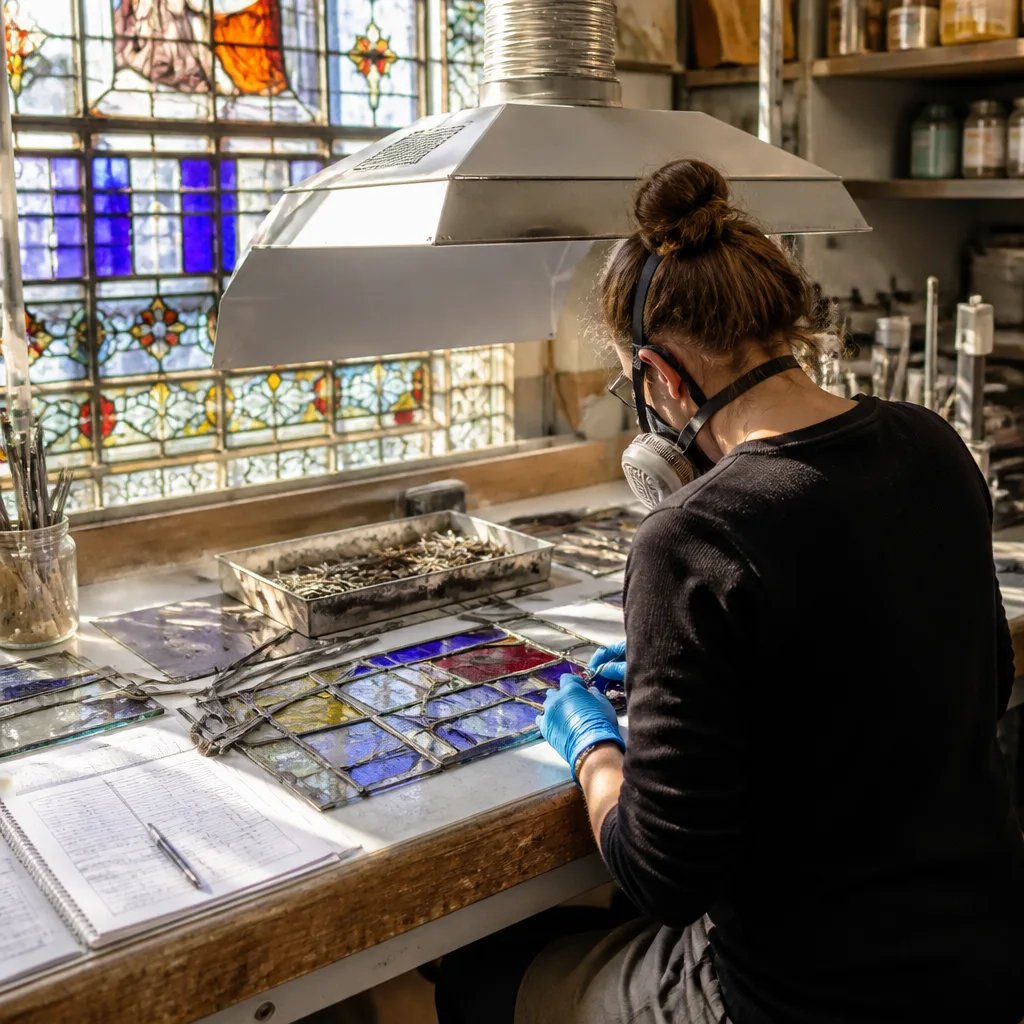
The oldest and largest stained-glass studio in the UK has warned that proposed new limits on lead in blood could make conservation work impossible and force staff — particularly women — from the workforce.
Regulatory change and immediate consequences
The Health and Safety Executive (HSE) is consulting on lower permissible blood-lead levels for people who work with lead. The proposals would reduce the threshold that triggers removal from lead work for employees across the board and impose a substantially lower limit for pre-menopausal women because of reproductive risks.
| Category | Current threshold (micrograms per decilitre) | Proposed threshold after two-year transition (micrograms per decilitre) |
|---|---|---|
| All employees (immediate suspension level) | 60 | 15 |
| Pre-menopausal women | 30 | 7.5 |
York Glaziers’ Trust, responsible for the medieval glass at York Minster and numerous heritage sites, says the proposals would be "unworkable" for conservators whose craft requires direct contact with the lead cames that hold fragments of glass together.
"The immediate impact for me would be that I'm out of a job,"
The speaker, a conservator employed by the trust for two years, currently records a blood-lead reading of 8 micrograms per decilitre — within existing legal limits but above the proposed level for pre-menopausal women.
Workplace practices and preservation concerns
Conservators at the trust say they already take a range of precautions to limit exposure. Those measures include:
- personal protective equipment and masks,
- close-up extractor fans to remove dust, and
- other established mitigation practices while handling historic material.
Despite these controls, the trust argues that the nature of stained-glass conservation — which entails unavoidable contact with lead cames and potential disturbance of old dust and solder — means workers will reach the proposed lower limits even when following best practice. The trust warns the practical effect could be either closure of specialist workshops or an effective ban on employing women of child-bearing age in these roles.
Health evidence and advisory input
Officials advising the HSE say the rules have not been reviewed in more than two decades. Newer research cited by a member of the advisory committee points to additional cardiovascular risks associated with lead exposure for both men and women, alongside the recognised risk to foetuses and infants from maternal lead mobilisation during pregnancy.
Professor Alastair Hay, emeritus professor of environmental toxicology at the University of Leeds and a member of the HSE’s advisory committee on toxic substances, has highlighted studies suggesting an increased risk of heart attack linked to lead exposure. He also emphasises the particular concern for women who may become pregnant, given the potential for lead to enter the bloodstream and reach the developing baby.
Implications and questions ahead
The proposed thresholds raise several immediate policy and operational questions. If implemented, would the new limits be accompanied by targeted exemptions, alternative work pathways, or funded programmes to reduce employees’ lead burden? How would heritage employers recruit and retain specialist conservators if a large proportion of experienced staff were removed from lead work by mandatory medical thresholds?
For now, the HSE’s consultation remains open and subject to further evidence and stakeholder input. The debate highlights a persistent tension between protecting worker health based on emerging scientific evidence and preserving specialised skills needed to maintain cultural heritage.
Any decision will carry consequences for public-health protection, workplace equality and the long-term stewardship of historic stained glass — a complex intersection of labour, science and conservation policy.