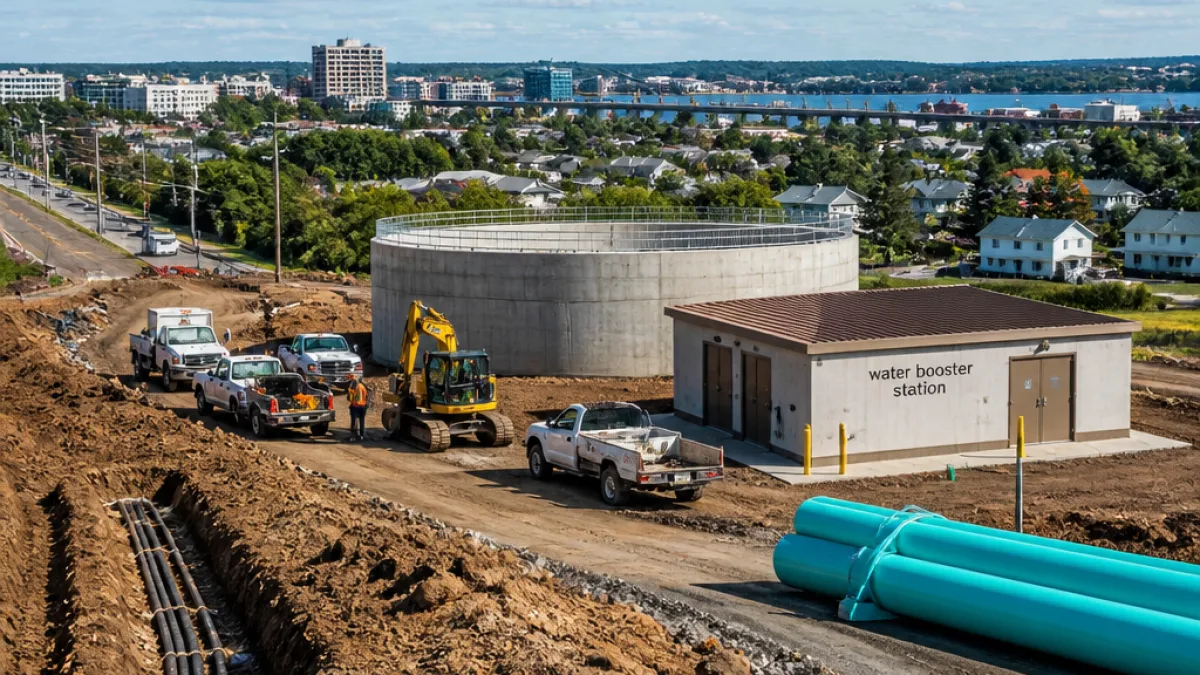
Federal, provincial and municipal governments are jointly funding an extension of water, wastewater and stormwater infrastructure in Fredericton that city officials say will open up land for a substantial new residential development.
Combined investment to spur housing development
Officials announced that the Canada Housing Infrastructure Fund (CHIF) will contribute more than $9.4 million, the province will provide more than $7.8 million and the City of Fredericton will invest more than $6.3 million toward work along Doak Road. Municipal leaders say the upgrades will facilitate construction of more than 1,300 homes on about 44 hectares of city-owned land.
The project includes the installation of several kilometres of new water and sewer piping, construction of a new water reservoir with a booster station and upgrades to the Wilsey Road lift station. City staff have described the initiative as necessary to service a new neighbourhood that will accommodate single-family houses, townhouses and apartment buildings.
What the work will involve
- Several kilometres of new water mains and sanitary sewer pipes.
- Construction of a water reservoir and booster station to maintain supply and pressure.
- Upgrades to the Wilsey Road lift station to handle increased flows.
Municipal officials say these components are designed to deliver serviced lots more quickly, allowing developers to build at a faster pace than would be possible without the infrastructure in place.
Policy context and intended outcomes
The federal government framed the contribution as part of broader efforts to address the national housing shortage by supporting municipal infrastructure that enables more housing supply. The announcement references federal initiatives aimed at increasing the pace and scale of homebuilding, including new programming intended to finance construction and encourage modern building practices.
For Fredericton, the project is intended to help meet municipal population growth targets and to provide ready-to-build areas for future residential development. Local planners say unlocking city-owned land is a cost-effective way to expand housing options while retaining municipal control over how the land is developed.
Numbers at a glance
| Partner | Investment |
|---|---|
| Federal (CHIF) | More than $9.4 million |
| Provincial | More than $7.8 million |
| Municipal (City of Fredericton) | More than $6.3 million |
| Land unlocked: 44 hectares; Homes enabled: over 1,300 | |
Local impacts and considerations
Beyond increasing the housing stock, the infrastructure expansion will place new demands on municipal services, transportation networks and schools. City planners will need to coordinate land-use approvals, design standards and servicing timelines with builders to ensure the neighbourhood develops in line with community priorities.
While officials emphasise the benefits of ready-serviced lots — including potentially faster and lower-cost home construction — residents and stakeholders often look for details on phasing, timelines and the proportion of units that will be affordable or rental housing. Those specifics have not been announced as part of the infrastructure funding notice.
Why infrastructure matters to housing supply
Municipal infrastructure — water, sewer and stormwater systems — is a precondition for most residential development. Without it, lots cannot be serviced and building permits cannot be issued. By investing in these systems up front, governments can reduce barriers to development and influence the pace at which new housing appears on the market.
Officials say the Doak Road work is intended to remove one such barrier in Fredericton and to help align public investment with private-sector construction activity.
The project is part of a broader national effort that pairs infrastructure funding with other housing measures; in this case, federal authorities described the work as complementary to separate federal programs aimed at financing and building affordable homes.
City officials will provide further details on timing and contracting as the project moves from planning to construction. For residents, the investment signals a concrete step toward increasing the supply of homes in Fredericton’s growing urban area.