Carol Taylor, a courtroom sketch artist who recorded criminal proceedings across New Brunswick for more than 40 years, has seen her work acquired and catalogued by the Canadian Museum of History in Ottawa. The collection recognises a distinctive visual archive of the province’s legal history and the craft of courtroom illustration.
From Burton courtrooms to a national collection
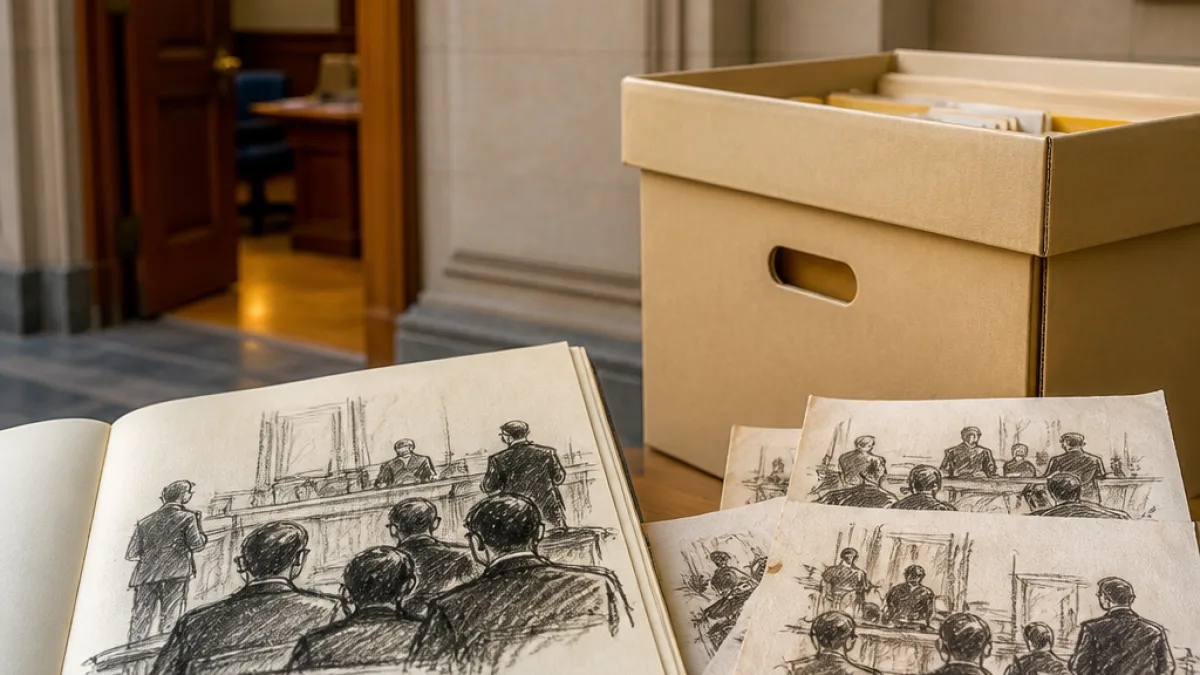
Taylor’s sketches — produced under the constraints of busy courtrooms, strict rules about photography and ever-shifting scenes — now form part of a national repository that preserves how trials, victims, defendants and courtroom dynamics were represented before digital recording became widespread.
The artist’s presence in New Brunswick courthouses is well known locally. The Telegraph-Journal’s report on the acquisition recalls an early scene: Taylor arriving in a near-empty courtroom in Burton to set up her supplies and catching a cold glance from an accused who was already shackled. That anecdote captures both the intimacy and tension of courtroom sketching.
Why the collection matters
Sketches like Taylor’s serve several functions. They provide a visual record where photography and video are restricted, they humanize legal proceedings by focusing on faces and expressions, and they document moments in the province’s criminal and civil history that might otherwise be recorded only in text.
Preservation at the Canadian Museum of History gives Taylor’s work longevity and broader access. For researchers, journalists and the public, the collection will be a resource to study courtroom culture, legal theatre and the evolution of court reporting over decades.
- Artist: Carol Taylor
- Career span: more than 40 years (as reported)
- Notable venue mentioned: Burton courtroom
- Acquiring institution: Canadian Museum of History, Ottawa
- Related publication: Capturing Crime (2019), a book chronicling Taylor’s career
Local legacy and professional craft
In a province where many trials attract significant community attention, Taylor’s drawings have threaded public events into a visual narrative. Her work appears to have documented both high-profile cases and quieter hearings, offering multiple perspectives on how justice is administered in New Brunswick.
Courtroom sketching is a specialised discipline. Artists must work quickly and discreetly, often from a gallery bench or at the back of the courtroom, producing images that capture posture, expression and atmosphere with a limited palette of media and time. Taylor’s body of work, now archived, exemplifies the combination of artistic skill and journalistic purpose that the form demands.
What the museum catalogue means for New Brunswickers
For families, journalists and historians in New Brunswick, the museum acquisition formalises the significance of a provincial visual record. Items placed in national collections are typically described, conserved and made accessible under professional archival standards, which increases the likelihood they will be consulted by future generations.
| Item | Detail |
|---|---|
| Artist | Carol Taylor |
| Career length | More than 40 years |
| Book documenting career | Capturing Crime (2019) |
| Archive location | Canadian Museum of History, Ottawa |
Those interested in viewing the collection should contact the Canadian Museum of History for access details, as many archived items are digitised or made available to researchers by appointment.
Preserving a visual record of justice
As technology and media access change, courtroom sketching has declined in some places, but the practice remains an important backup and artistic response to restrictions in open court coverage. Taylor’s drawings now serve as a reminder that courtroom imagery is not purely evidentiary; it is also cultural, reflective and interpretive.
The acquisition honours an artist who quietly chronicled the province’s courts and offers New Brunswickers a preserved window into decades of judicial life. It also highlights how regional practices — a single artist’s bench in a small-town courtroom — can gain national recognition when institutions decide to safeguard those records.
For New Brunswick’s legal community, journalists and the public, the collection is both a milestone and an invitation: to revisit past proceedings through a visual lens and to consider how justice and its depiction have changed over time.