
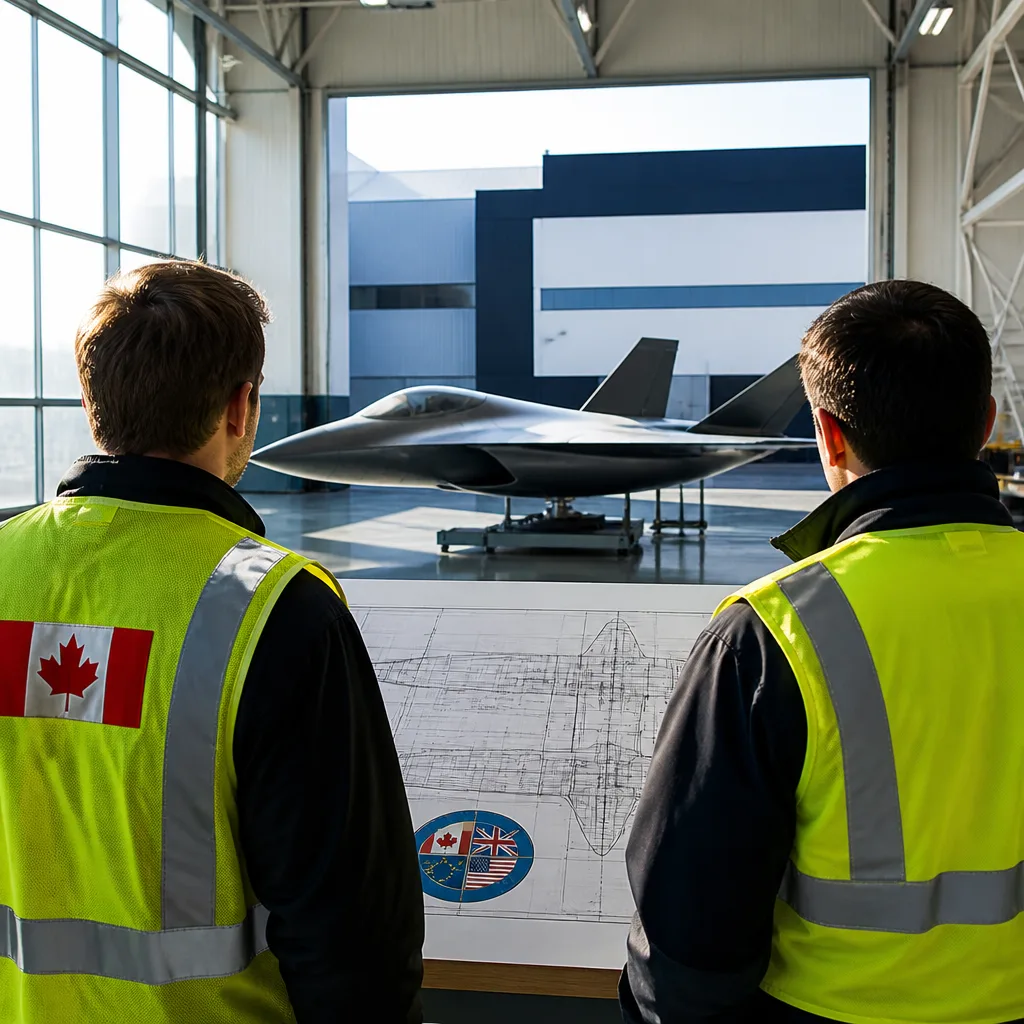
Bombardier Inc. says Canada’s newly announced observer role in an international stealth fighter project could create a pathway for the Montreal aerospace firm to contribute engineering expertise and expand its defence business.
Observer status opens learning and potential contracting opportunities
On July 21, Canada was granted observer status in the Global Combat Air Programme (GCAP), a multinational effort launched in 2022 that brings together Italy, Japan and the United Kingdom to develop a sixth‑generation supersonic stealth fighter targeted for around 2035. The program is intended to produce successors to aircraft such as the Eurofighter Typhoon and Japan’s Mitsubishi F‑2.
Speaking on a conference call this week, Bombardier chief executive Éric Martel said the arrangement could let the company “see if we can have a role in the future,” and position Bombardier to offer engineering resources and support as the program evolves.
"New technologies are being developed, and it's of interest for us to … see if we can have a role in the future," Éric Martel said. "Bombardier could have an interest in … providing engineering resources and support to the program, and learning from this, and then after, if ever opportunities arise that are of interest, we could definitely get into this sphere."
Martel told analysts that momentum in Bombardier’s defence activities is building, with sustained customer interest internationally and a growing pipeline. The company, long known for business jets, has been expanding into defence work in recent years.
What observer status means and why industry cares
The four countries behind GCAP said Canada’s observer role will provide enhanced insight into the program’s capabilities and industrial framework, and afford opportunities to deepen understanding of security requirements and partnering prospects. In their joint statement, the partners added that Canada’s involvement supports alignment of strategic priorities and helps strengthen global security.
- Access to technical briefings: Observer status typically allows insight into developmental technologies and requirements that could inform suppliers and integrators.
- Industrial positioning: Early engagement can help companies qualify for future subcontracting or teaming arrangements if procurement decisions widen beyond initial partners.
- Skills transfer: Participation can accelerate knowledge gains for civilian and defence engineering teams, with potential spillovers to business aviation products.
For Bombardier, that kind of early exposure could translate into specific offers to provide engineering support, though Martel stopped short of promising any contracts. He framed the activity as both a learning opportunity and a way to evaluate whether Bombardier should pursue a greater role.
Industry context and consequences
Bombardier’s interest comes as the company reports growing relationships in key markets that overlap business aviation and defence. That positioning — decades of engineering work on business jets combined with recent defence contracts — could make it attractive as programmes like GCAP explore broad industrial partnerships.
Precise commercial implications for Canadian industry will depend on how the GCAP partners structure future procurement, offset arrangements and security criteria. Observer status does not guarantee access to classified program elements or to downstream contracting; it does, however, offer an earlier line of sight than absent participation.
For Ottawa, the move underscores a strategy of seeking deeper involvement in advanced defence projects without committing as a full partner. The stated aim in the partners’ release was to enhance mutual understanding of combat air ambitions and align strategic priorities — a diplomatic as well as industrial outcome.
| GCAP fact | Detail |
|---|---|
| Launch year | 2022 |
| Targeted in‑service date | 2035 |
| Primary partner countries | Italy, Japan, United Kingdom (Canada as observer) |
Bombardier’s CEO said the company’s defence pipeline is expanding and that its longstanding relationships in many regions are creating opportunities across both business aviation and defence. How large a role Bombardier might play — from engineering services to manufacturing work — will be shaped by future program rules, security requirements and whether formal industrial partnerships are offered to observer nations or their suppliers.
As the GCAP effort advances toward demonstrator phases and capability definition, Canadian firms and the federal government will watch closely for openings that match domestic industrial capacity and policy aims, including jobs, technology transfer and sovereignty considerations.