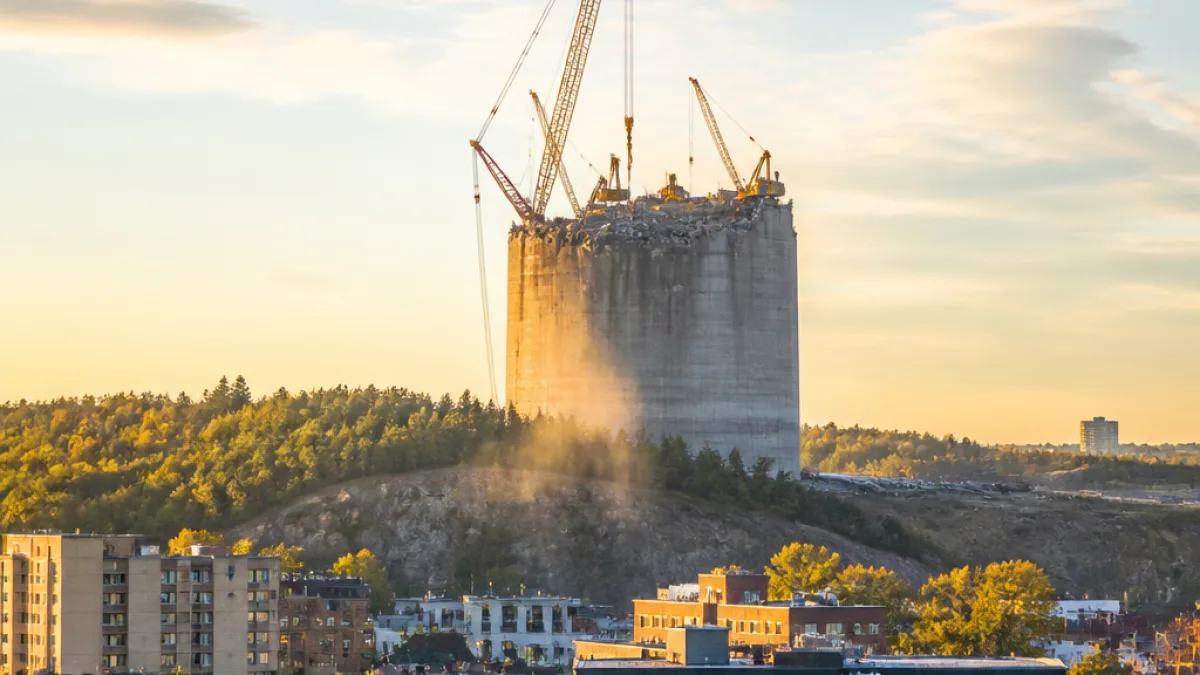
Work to dismantle the Superstack at Vale's Copper Cliff smelter is advancing in measurable stages, the company says, with the downtown-visible chimney now more than 200 feet shorter than at the start of formal demolition this summer.
Progress and method
In a July 24 social media update, Vale Base Metals reported the 1,250-foot (381-metre) stack had been reduced by 210 feet (64 metres) since demolition began formally on June 1. The remaining structure stands at about 1,036 feet (315.7 metres), a height the company notes is roughly comparable to when the concrete pour was underway in July 1970.
International demolition firm ICC Commonwealth is leading the project, using a top-down removal technique. That approach relies on concrete-breaking equipment at the chimney’s summit to incrementally reduce the structure. Vale said early preparatory work began in 2025 with the removal of the stack’s liner, and the specialist contractors expect the full demolition to take three to four years.
Historical context and environmental significance
Built beginning in the summer of 1970 and brought into operation in 1972, the structure has long been a prominent industrial landmark on Sudbury's skyline. Designed to disperse smelting emissions over a broad area, the stack was, at the time of construction, considered an engineering achievement and became the tallest chimney in the Western Hemisphere.
The stack’s role in spreading emissions also played a part in Sudbury’s later environmental story. Ground-level pollution from decades of nickel smelting spurred community and industry efforts to regreen areas around the city. The Superstack was taken out of service after Vale completed the $1‑billion Clean AER project in 2020, which included a wet gas cleaning plant to substantially reduce sulphur dioxide emissions.
Local impact and what to expect
For residents, the dismantling will be a long-running change to a familiar skyline. The work is deliberate and staged. Vale’s timeline anticipates multiple seasons of activity as machinery and crews remove the chimney from the top down.
The project also underscores continuing investment in modern emissions control at the Copper Cliff smelter, and highlights a transition away from the old dispersion model toward on-site capture and treatment of pollutants. That shift has local environmental and public-health implications the company has referenced since the Clean AER system began operation.
At a glance
- Original height: 1,250 ft (381 m)
- Height removed since June 1 formal demolition start: 210 ft (64 m)
- Current height as of July 24 update: 1,036 ft (315.7 m)
- Demolition method: Top-down concrete breaking
- Expected duration: Three to four years
“We truly are starting to notice the Superstack getting shorter day by day,” Vale said in its Facebook post.
| Date | Event | Height (ft) |
|---|---|---|
| 1970–72 | Construction and commissioning | 1,250 |
| 2020 | Clean AER project placed into service; stack taken out of operation | 1,250 |
| 2025 | Pre-demolition liner removal | 1,250 |
| 2026 (July) | Formal top-down demolition underway | 1,036 |
As the work continues, residents can expect continued updates from Vale and on-site contractors. The long-term project will reshape a familiar part of Greater Sudbury's built environment, reflecting both the city’s industrial history and its ongoing efforts to modernize smelting operations and reduce emissions.
Reporting on this story will continue as Vale and ICC Commonwealth provide further milestones and safety or traffic advisories related to the demolition.