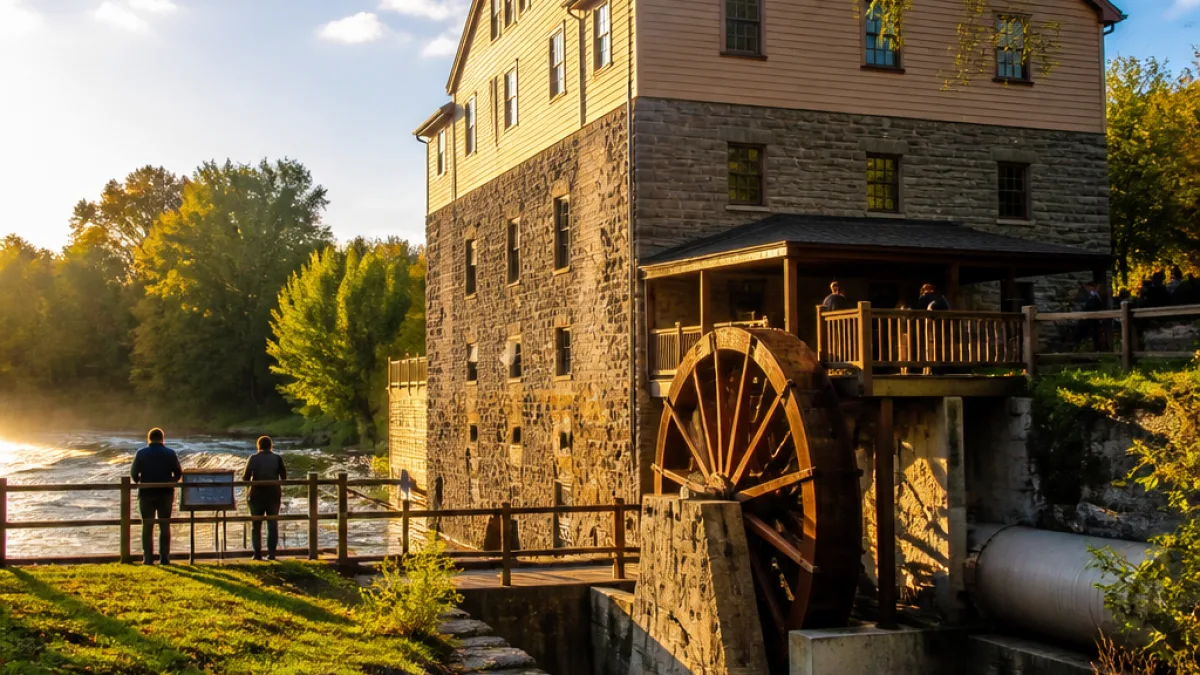
The City of St. Catharines and the volunteer group Friends of Morningstar Mill have completed a $2-million restoration of Morningstar Mill on the banks of Beaverdams Creek, reopening public access to a site that residents and local historians say helped shape the city’s earliest settlement and economy.
From frontier supply to heritage attraction
There has been a mill on the Morningstar site since just after the War of 1812, and through the 19th and early 20th centuries the complex expanded to include a grist mill, a sawmill and associated buildings. Before retail supply chains and modern bakeries, local settler communities relied on water‑powered mills to produce flour and lumber.
“This is the beginnings of the settlement area here in St. Catharines,” said Mayor Mat Siscoe, summarising the civic importance of having a working mill nearby during the region’s early growth. He added that a local grist mill helped sustain population increases by supplying flour for baking.
What the restoration preserves
The project restored both the building fabric and historic machinery. Visitors to the reopened mill can now view an 1892 version of modern milling alongside older whole‑wheat technology. Much of the equipment on display was designed to produce the white flours that became popular in the late 19th century.
“This is the modern equipment that is here to grind grain — whatever it is, whichever kind of grain it is essentially,” said Kathleen Powell, curator with St. Catharines Historical Services. She pointed out that all of the milling operations at Morningstar were driven by water power, with a shaft extending down to a turbine that the flow of Beaverdams Creek turned.
“The mill is great. Like coming in to see the mill itself and all of the equipment and how it works is pretty great, because there are not a lot of mills left in, especially in Niagara.” — Kathleen Powell, St. Catharines Historical Services Curator
Community and operational details
The refurbishment brings together municipal investment and volunteer support. The City of St. Catharines coordinated the project and worked with the Friends of Morningstar Mill to complete repairs and conservation work that had closed the site for years.
- Location: Morningstar Mill, along Beaverdams Creek, St. Catharines.
- Project cost: $2 million, completed by the city and volunteer partners.
- Heritage features: 1892 milling equipment, water‑powered turbine and historic mill structures.
Local significance and next steps
City officials and heritage advocates describe Morningstar Mill as foundational to the settlement and economic life of St. Catharines. Restoring the mill preserves an educational resource for residents and visitors, and reinforces the city’s connection to its industrial and agricultural past.
Friends of Morningstar Mill have played a consistent role in stewardship and programming at the site. With the refurbishment complete, the site can be used more reliably for tours, school visits and interpretive activities that explain how water power and milling technology supported community life before modern supply systems.
| Feature | Notes |
|---|---|
| Historical span | Mill presence since just after the War of 1812; 19th/20th century expansion |
| Power source | Water‑driven turbine from Beaverdams Creek |
| Equipment on display | 1892 milling machinery and earlier whole‑wheat apparatus |
The reopening is likely to have ripple effects across local heritage programming and tourism, offering an accessible site where residents can connect with the mechanics of daily life in early St. Catharines. For educators, historic preservationists and families, the mill provides a tangible demonstration of how water power and local industry shaped settlement patterns and daily routines.
As access to Morningstar Mill returns, municipal and volunteer groups will be watching how programming and visitation develop, and whether the restored site can anchor wider heritage and recreation initiatives along Beaverdams Creek and in neighbouring parklands.