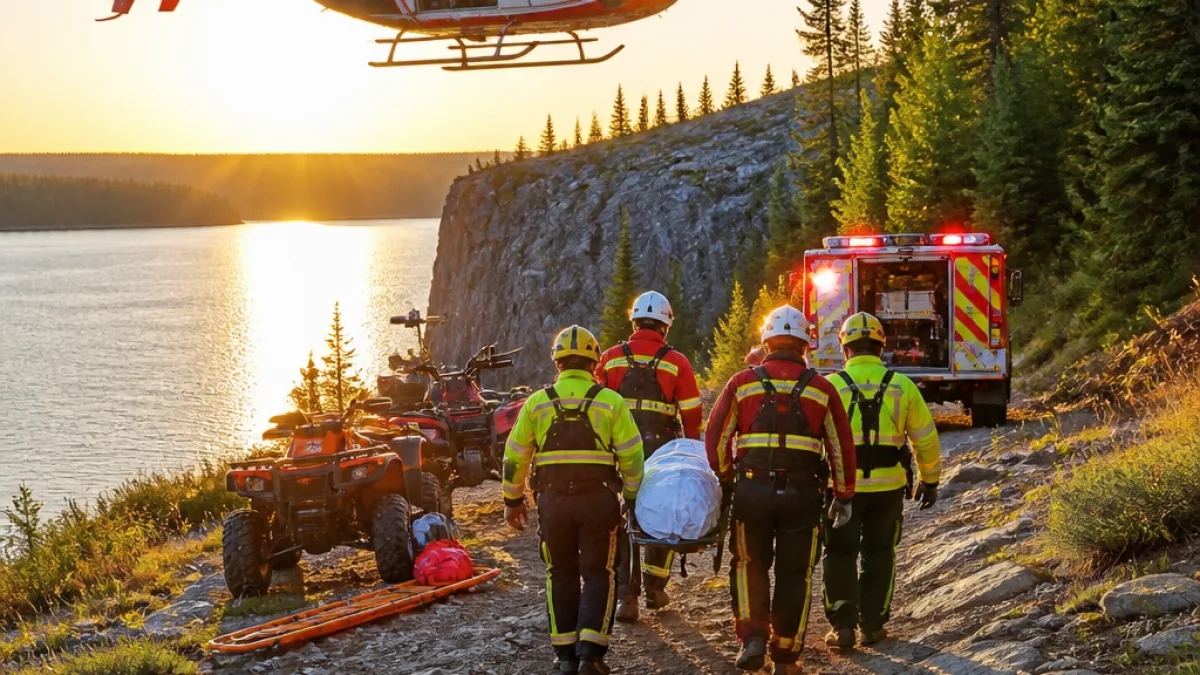
A 32-year-old man is recovering in hospital after a cliff-jumping accident at Alberts Lake in northern Manitoba that prompted a multi-agency rescue and air evacuation. Manitoba RCMP said officers were called about the incident on the evening of July 18, after reports a man had been injured at the remote lake east of Flin Flon.
Remote scene required off-road access and coordinated response
RCMP said the initial call came in at about 9:30 p.m.. Because there is no road access to Alberts Lake — roughly 20 kilometres east of Flin Flon — first responders were instructed to bring all-terrain vehicles to reach the location.
Police coordinated rescue efforts with local firefighters, conservation officers and emergency medical services. Responders followed a trail to the scene and found the injured man about five kilometres down from the drop-off point, where he was in a boat with a 31-year-old woman.
The woman told first responders the man had been cliff jumping at the lake when he struck rocks and was injured. She had managed to get him into the boat, take him to shore and provide first aid until emergency personnel arrived.
Air evacuation to Saskatchewan hospital
Given the seriousness of his injuries and the remote location, the man was flown to hospital in Saskatoon. RCMP said he remains in hospital and is recovering from serious injuries.
| Detail | Information |
|---|---|
| Date and time | July 18, call at about 9:30 p.m. |
| Location | Alberts Lake, ~20 km east of Flin Flon |
| People involved | 32-year-old male (injured), 31-year-old female (companion) |
| Response | RCMP, local firefighters, conservation officers, EMS, air evacuation |
Safety concerns in remote recreation areas
This incident highlights ongoing risks associated with remote outdoor recreation in northern Manitoba. The combination of limited access, hazards such as submerged or exposed rocks at popular jumping spots, and the time required for responders to reach remote locations can greatly affect outcomes following an injury.
While specific circumstances that led to the impact with rocks were not detailed by police, the RCMP account underscores two recurring safety issues:
- The challenge of rapid medical access in areas without roads, where responders must travel by ATV, boat or foot.
- The importance of immediate first aid by companions, who may be the only help available until responders arrive.
Local search-and-rescue resources and emergency services often rely on coordination between municipal crews and provincial agencies to overcome access barriers. In this case, the combined efforts of police, firefighters, conservation officers and EMS enabled the injured man to be stabilised and airlifted to a hospital equipped to treat his injuries.
Advice for residents and visitors
Recreational cliff jumping continues to result in serious injuries in Canada and elsewhere when depth, underwater hazards or landing zones are misjudged. Visitors to lakes and remote recreational areas should consider the following precautions:
- Scout jumping sites carefully and never assume water depth is safe without checking for submerged rocks or sudden shallows.
- Bring a companion and a basic first-aid kit; ensure someone knows your itinerary and expected return time.
- Carry a communication device suitable for the area, and know the limitations of cell coverage in remote parts of northern Manitoba.
- If an injury occurs, provide first aid when safe, call local emergency numbers and be prepared to relay location details to dispatchers.
Manitoba RCMP did not release further details about the man's identity or the precise nature of his injuries. The matter remains an active reminder of the potential dangers of cliff jumping and the critical role of multi-agency response in remote northern communities.
Officials in Flin Flon and regional emergency services did not immediately provide additional comment beyond the RCMP news release.