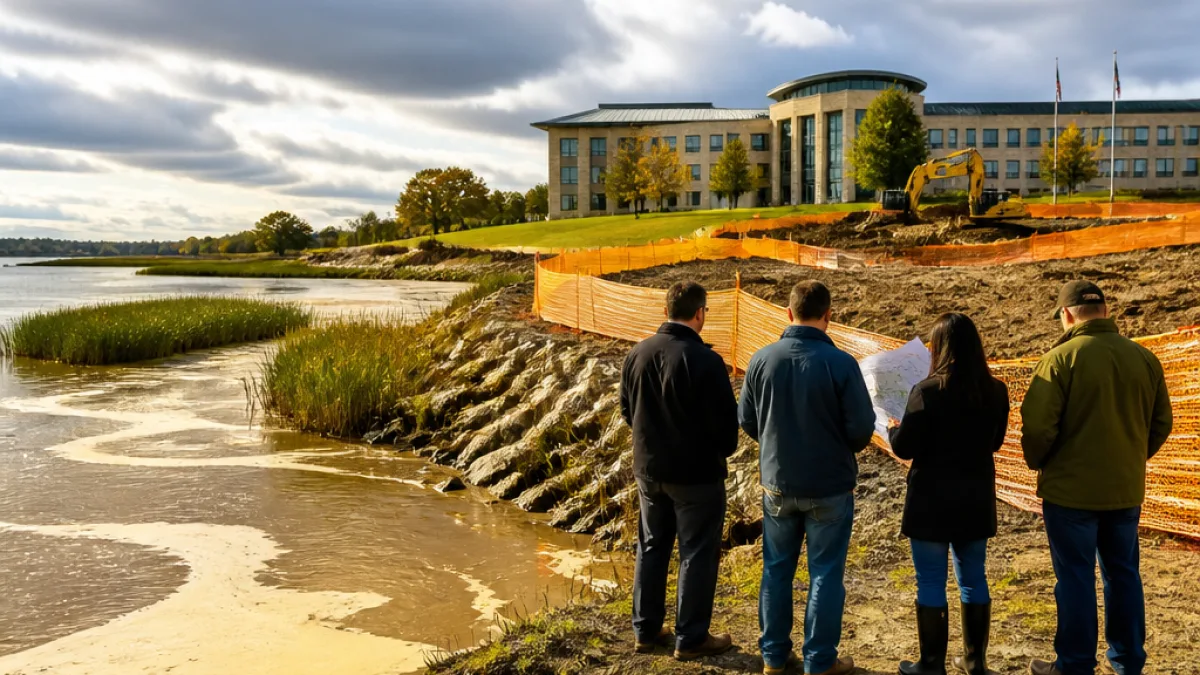
The dispute over contaminated runoff into the Murrells Inlet Estuary has resulted in an agreement between a local conservation group and Georgetown County government that will create a new municipal committee to review and improve stormwater work.
Background and the legal prompt
Members of Preserve Murrells Inlet raised concerns about construction sites and other land‑disturbing activity that they say were delivering sediment — and the bacteria hitchhiking on it — into local waterways. Those concerns led the South Carolina Environmental Law Project (SCELP) to notify Georgetown County in 2024 of its intent to sue over water quality issues tied to the county’s implementation of its Municipal Separate Storm Sewer System (MS4) permit.
SCELP staff attorney Monica Whalen told county officials the complaint centred on bacteria from faecal sources and other pollution entering the estuary, particularly through stormwater that moves sediment and associated contaminants into the tidal system.
“So one pathway of this, bacteria is that it can hitchhike on sediment and then when it rains that, that, that washes the sediment into the water bodies, including the estuary,”
The discussion reached the Georgetown County Council and negotiations followed. Rather than immediate litigation, the county and Preserve Murrells Inlet agreed a path forward focusing on evaluating and improving the county’s MS4 permit implementation.
What the agreement does
Under the terms reported by SCELP and the local group, the agreement will:
- Establish a county committee charged with evaluating stormwater projects and the county’s current approach to MS4 permit obligations.
- Address sources of bacterial contamination, including sediment-borne bacteria from construction sites.
- Provide a framework for the county to improve its inspection, erosion and sediment control, and post‑construction runoff practices.
Supporters of the agreement say it is meant to create a structured, local path to protect the estuary without immediate court action. Preserve Murrells Inlet members had previously appealed to other agencies and found limited support, prompting the legal notice that ultimately produced the negotiated outcome.
Local implications and next steps
The negotiated approach shifts the immediate focus from courtroom confrontation to administrative and technical review. For residents and shoreline users, the agreement could mean more attention to how construction permits are issued and enforced and to the measures required to limit sediment and bacterial runoff during and after development.
Key next steps reported include the formal establishment of the county committee and the initiation of an evaluation of current practices under the MS4 permit. The county will be expected to examine:
| Area of review | Purpose |
|---|---|
| Erosion and sediment controls | Reduce sediment mobilisation from construction sites |
| Inspection and enforcement | Ensure required measures are implemented and maintained |
| Post‑construction stormwater management | Limit runoff and contaminant transport into estuary |
Preserve Murrells Inlet and SCELP framed the agreement as a necessary step to protect water quality and public health, while county officials have presented it as a way to address concerns without protracted litigation. The precise membership, mandate and timeline for the newly created county committee have yet to be published by the county council at the time of reporting.
Why this matters beyond Georgetown County
Municipalities across North America face similar tensions between development activity and water quality protection. This agreement highlights several themes relevant to communities like ours in Ontario:
- The role of third‑party legal pressure in prompting municipal reviews of environmental permits and practices.
- The practical importance of erosion control at construction sites to prevent downstream bacterial contamination.
- The value of transparent, locally based committees to monitor and recommend improvements to stormwater systems.
For residents who recreate on or live near water, and for municipal officials balancing growth with environmental stewardship, the Georgetown County outcome will be worth watching as it moves from agreement to action. Further updates are expected as the county defines the committee’s structure and publishes its plan to implement the agreement.
(Reporting from public statements and filings by Preserve Murrells Inlet and the South Carolina Environmental Law Project, and coverage by WPDE/ABC News 4.)