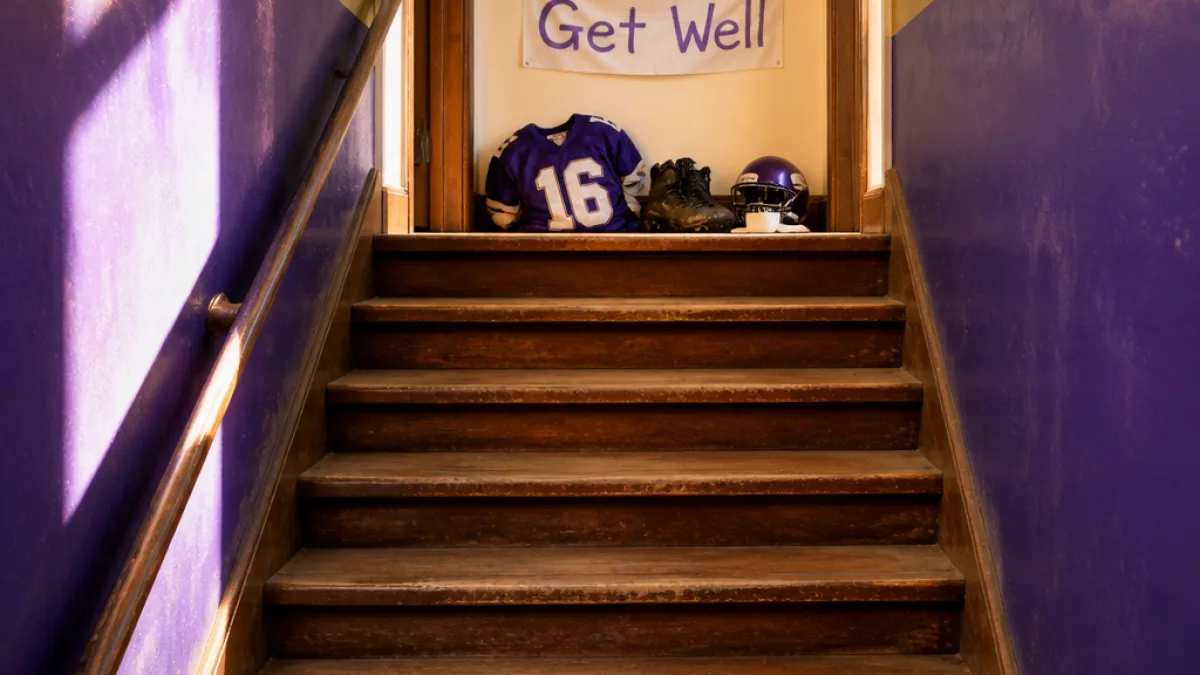
SASKATOON — There are 16 steps to the top-floor bedrooms of a student house near the University of Saskatchewan. For Anton Amundrud, they became an unexpected measure of how far he had fallen.
A season that turned
Midway through last season, Amundrud was the country’s top story at the U Sports level. Through five games the University of Saskatchewan quarterback had averaged 328 passing yards per game, guiding the Huskies to an unbeaten start and emerging as an early favourite for the Hec Crighton Trophy as Canada’s best university football player.
Then, almost overnight, everything changed. Within weeks he lost more than 30 pounds, became bald, lost his eyebrows and found himself in hospital receiving chemotherapy after a diagnosis of T-cell non-Hodgkin’s lymphoma complicated by hemophagocytic lymphohistiocytosis. Where he once strode across a field with authority, he struggled to climb 16 steps without clutching the railing and taking four minutes to reach his bedroom.
The team’s reaction
News of the diagnosis hit the Huskies hard. In an impromptu meeting that included university officials, head coach Scott Flory delivered the grim update to the team. “
He’s in the fight of and for his life,” Flory told the assembled players, words that underscored the gravity of Amundrud’s condition.
Teammates remember the player who had been performing at an elite level just weeks earlier. Ryker Frank, a fifth-year running back, said the quarterback had been “playing lights-out football.” Strength and conditioning coach Joel Lipinski praised his size and accuracy: “He was big, he was strong, he was making all the throws.”
Medical battle and recovery
The illnesses Amundrud faced are both serious and complex. T-cell non-Hodgkin’s lymphoma is an aggressive cancer of the immune system; hemophagocytic lymphohistiocytosis is a rare, severe immune reaction that can accompany malignancy or infection and requires intensive treatment. The source material describes his ordeal in physical detail, from dramatic weight loss to the basic struggle of climbing stairs.
Public accounts emphasise the contrast between the athlete who had been a national candidate for individual honours and the patient who needed help with the most ordinary movements. That gap — the pre-illness peak and the rawness of treatment — is central to understanding the scale of his comeback.
What his return means locally
Amundrud’s story matters in several ways to Saskatchewan sports and the university community. On the field, the Huskies lost their commanding leader during a critical season stretch. Off the field, his illness and recovery became a focal point for teammates, coaches and fans, a reminder of how fragile elite athletic careers can be and how communities rally when someone faces life-threatening disease.
For younger players and fans, the arc also provides a visible example of resilience. It highlights the intersection of elite sport and health care: how diagnosis, treatment and rehabilitation can interrupt careers, and how return-to-play decisions must balance physical recovery with long-term wellbeing.
Practical context and supports
While the details of Amundrud’s specific treatment plan are private, his experience points to several practical realities for athletes and families:
- Serious illnesses can present rapidly; early assessment and referral to specialists matter.
- Rehabilitation after chemotherapy or immune-system disorders may require stepwise conditioning and medical clearance before full-contact play.
- Teams and institutions often provide mental-health and academic supports to help athletes manage recovery and return to studies.
The broader picture
Amundrud’s story will be followed closely in Saskatoon and across the Prairies because it is not just about statistics or one season: it connects to community identity, young athletes’ aspirations and the often-hidden demands of recovery. When the quarterback can climb those 16 steps quickly again, it will be a small but powerful sign that he has moved through a harrowing chapter.
For now, teammates and staff continue to remember how dominant he had been in those first five games — a benchmark that makes his return all the more remarkable. The Huskies and their fans will be watching, quietly hopeful that the player who once averaged 328 yards a game can regain his stride, and mindful of the care and time such a climb requires.
| Period | Key detail |
|---|---|
| Early season (first five games) | Average 328 passing yards per game; undefeated |
| Illness onset | Lost > 30 pounds; required chemotherapy |
| Recovery phase | Struggling with basic tasks (16 stairs took four minutes); staged return to activity |
Anton Amundrud’s road back to the field will be measured in many small returns: weight regained, stamina rebuilt, confidence restored. Each step up those 16 stairs is part of a story that matters to a city and a football program that learned how quickly a leader can become the patient — and how a community responds when that happens.