
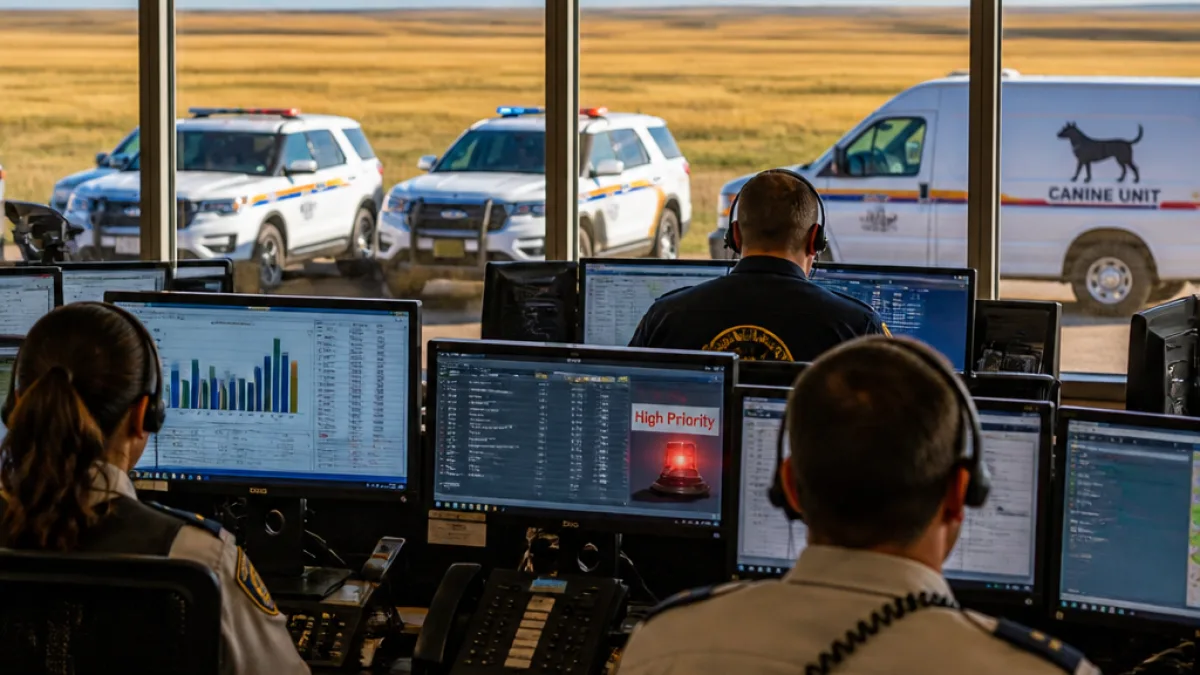
The Saskatchewan RCMP’s provincial call centre recorded 422,274 calls for service in 2025, a year-over-year increase of about 15 per cent, the federal police force said in a statement. That works out to an average of just under 1,157 calls per day, underscoring growing demand for policing across the province.
Rising volume and more serious incidents
Of those calls, the RCMP identified 4,801 as high-priority emergencies — incidents in which “police response is imperative to an individual’s, or the public’s, safety.” The force also reported increased use of specialist resources during 2025, with police dogs deployed 1,095 times and the Emergency Response Team sent out on 114 occasions.
“Investigations are rarely linear. They require frequent and immediate adjustments in strategy and resources,” RCMP superintendent Devin Pugh said in a statement.
Pugh said the Saskatchewan RCMP operates as a network of detachments, units and teams that can move personnel across the province when needed. He highlighted the force’s capacity to surge resources into areas experiencing acute demand.
Long-term trend
While the 15 per cent jump compares 2025 to 2024, the RCMP noted the number of calls received by the provincial call centre has risen about 58 per cent over the past decade. The pattern reflects both population shifts and changing expectations of police, as well as what the force described as increasing complexity in the files officers handle.
The RCMP also pointed to recent Crime Severity Index results showing that 60 of the province’s 80 detachment areas ranked above the national average, with 11 detachment areas marked more than ten times higher than the national figure. Those statistics, the force said, help explain why officers are regularly drawn from other detachments or specialist teams to support local responses.
What the numbers mean for communities
Higher call volumes can stretch police capacity, extend response times for non-urgent matters and place pressure on frontline officers. The RCMP’s ability to deploy dogs, tactical teams and personnel from other detachments helps mitigate some of that strain, but it also signals that many incidents now require specialised investigative or tactical response.
For residents, the changing profile of calls means two practical realities:
- High-priority emergencies remain the top operational focus for immediate police deployment.
- Non-urgent reports may be handled through alternative means or scheduled follow-ups as resources are prioritised.
Quick facts from RCMP Saskatchewan, 2025
| Measure | 2025 figure |
|---|---|
| Calls for service | 422,274 |
| Average calls per day | ~1,157 |
| High-priority emergencies | 4,801 |
| Police dog deployments | 1,095 |
| Emergency Response Team deployments | 114 |
Context and next steps
The RCMP frames the increases as a combination of rising demand and greater case complexity that often requires shifting resources and specialised skills. Superintendant Pugh said the force’s provincial structure gives it a unique ability to surge personnel where needed, a capability he said helps keep Saskatchewan communities safe.
Residents looking to reduce unnecessary emergency calls can review guidance from local detachments and municipal public-safety pages on when to call 911 versus non-emergency numbers. For matters that are not time-sensitive, contacting the local detachment directly or using online reporting tools (where available) can help ensure 911 lines remain open for urgent incidents.
The RCMP release did not break down calls by detachment or incident type beyond the high-priority total. Local detachments typically publish separate statistics and community alerts, and residents should monitor those channels for developments in their area.
As call volumes continue to climb, the conversation around police resourcing, community safety services and alternative response options is likely to intensify among municipalities, Indigenous leaders and provincial policymakers.