
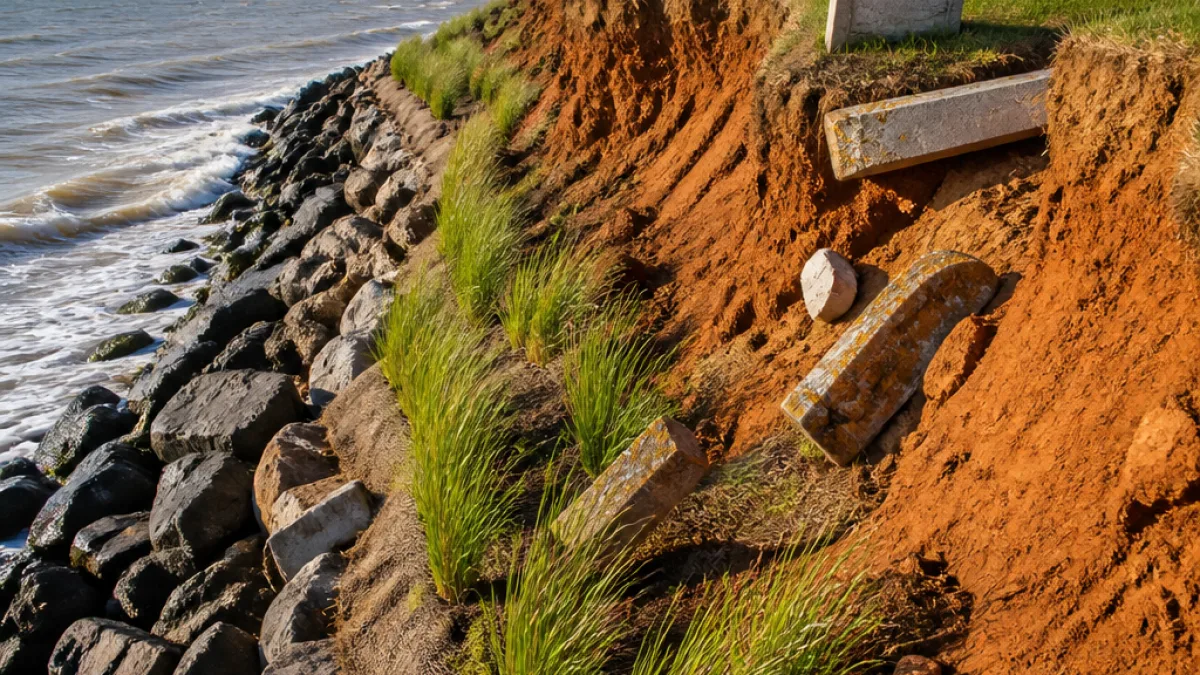
Two of Prince Edward Island’s oldest pioneer cemeteries are increasingly vulnerable to coastal erosion, provincial officials say, as storms and steady shoreline retreat expose and, in some cases, claim graves that date back more than two centuries.
Historic burial grounds at risk
Provincial archaeologist Christian Thériault identified the burial grounds at Panmure Island and St. Andrew’s Point in eastern P.E.I. as among the most threatened. He estimated the landforms beneath both cemeteries have retreated by roughly 30 metres since the 1930s.
“They're both very close to the edge. You can see parts of the cemetery collapsing,” Thériault said. “They’ve been actively eroding.”
Both cemeteries originate from early Scottish settlement on the Island. Records and markers show many burials date to the 1800s; the earliest known interment at St. Andrew’s Point is recorded as 1799. At Panmure Island, Thériault noted the first known burial was a young girl who died crossing to the island in winter.
Efforts to stabilise, but only temporary relief
The provincial government has tried several shoreline protection methods at the two sites. At Panmure Island, crews installed a so-called living shoreline in 2023, using natural materials and plantings intended to stabilise the edge and reduce erosion. Thériault described plantings such as shrubs and bayberry where hay bales were placed to encourage vegetation to take hold.
While such measures can slow the pace of loss and protect some burials in the short term, provincial officials and archaeologists stress they amount to buying time rather than a permanent solution. Rising seas, stronger storms and natural coastal dynamics make it difficult to guarantee long-term preservation of graves sited close to dynamic shorelines.
Losses already recorded
Thériault said parts of both cemeteries have already been lost to erosion, including some original burials and markers. That loss complicates efforts to document and interpret early Island settlement and family histories tied to those sites.
Heritage specialists face difficult choices when deciding whether to prioritise costly hard-protection works, accept managed retreat, or focus on documentation and salvage. The provincial archaeologist’s comments underscore the limits of protective interventions in exposed coastal locations.
- Sites identified: Panmure Island cemetery and St. Andrew’s Point cemetery.
- Estimated retreat: about 30 metres of shoreline loss since the 1930s at both sites.
- Interventions used: living shoreline with natural materials and plantings at Panmure Island (installed 2023).
| Site | Earliest known burial | Estimated shoreline retreat |
|---|---|---|
| Panmure Island cemetery | 1800s (first known: young girl who froze crossing in winter) | ~30 metres since 1930s |
| St. Andrew’s Point cemetery | 1799 | ~30 metres since 1930s |
What this means for Islanders
For families tracing genealogies, for communities holding ties to early settlement, and for the province’s archaeological record, the loss of burial grounds carries both emotional and informational cost. When grave markers and ground are lost to the sea, physical evidence of people’s lives and deaths — inscriptions, locations and material culture — can be gone forever.
Provincial efforts such as living shorelines are intended to reduce erosion pressure while favouring natural coastal processes. They can provide habitat benefits and often look less intrusive than traditional hard structures, but they require ongoing monitoring and maintenance and may not be appropriate where the coastline is highly exposed.
Officials describe the measures as delay tactics that provide time to document sites, to undertake conservation where possible, and to consult with affected communities. The broader challenge of supporting shoreline heritage on P.E.I. will continue to involve balancing heritage preservation, public safety and coastal management objectives.
As erosion progresses, Archie-based island communities and heritage groups may face difficult choices about whether to further invest in protection, to relocate markers and records inland, or to accept managed loss where the coastline is untenable.
For now, the visible collapse at both Panmure Island and St. Andrew’s Point serves as a reminder of the Island’s changing shorelines and the pressures they place on built and buried heritage.