
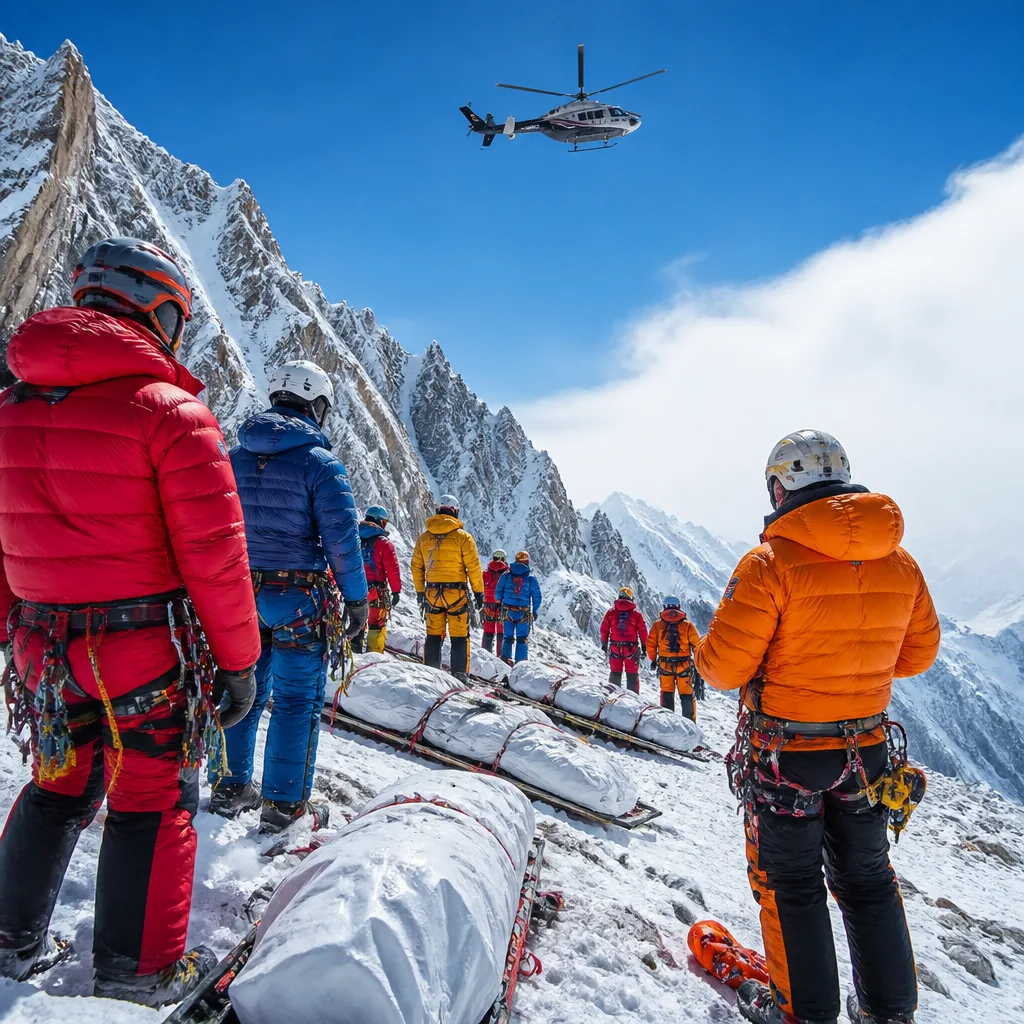
Rescuers in Pakistan have retrieved the bodies of seven climbers from Broad Peak after an avalanche struck the 8,051-metre Karakoram mountain, officials and expedition sources said, while search teams continue to seek the three remaining members of a 10-person international group.
High-profile casualty among the dead
Among the bodies recovered was Nirmal Purja, the 43-year-old Nepali-British mountaineer known internationally for climbing all 14 of the world’s 8,000-metre peaks in a record 189 days. His death was confirmed by his expedition company on Saturday and has reverberated through the global climbing community.
The avalanche struck Broad Peak at about midday on Thursday. The mountain, the world’s 12th-highest, is in Pakistan’s Karakoram range and poses one of the most remote and technically demanding environments for high-altitude climbing.
Recovery operations and challenges
Search teams located four bodies on Friday but were able to bring down only three that day because poor weather grounded helicopters. Over the following days, ground teams reached and retrieved additional remains, including Purja and three other climbers.
The recovered climbers represent a multinational expedition drawn from at least five countries: Nepal, Pakistan, Oman, the United States and China. Identified among the deceased were Nepali climbers Pur Bahadur Gurung (known as Yukta), Nima Sherpa and Kili Pemba Sherpa; Chinese climber Wang Zhong; Omani mountaineer Nadhira Al Harthy; and American climber Mallory Geis.
Three people remain missing, including Pakistani guide Sohail Sakhi, who was on what was intended to be his final expedition before retirement. Authorities and rescue coordinators cautioned that the search continues under arduous conditions.
Limitations and regional capacity
Officials noted the recovery mission was complicated by Pakistan’s limited capacity for long-line helicopter rescues, a capability more developed in neighbouring Nepal where high-altitude evacuations are more routine. Bad weather and the remoteness of the scene further constrained air support and complicated ground access.
As teams worked at high altitude in difficult terrain, rescuers faced the dual risks of unstable snow slopes and rapidly changing meteorological conditions, which often hamper operations and increase the danger to search personnel.
International impact and context
Purja’s rise from former Gurkha soldier and special forces member to global celebrity — propelled by his 2019 achievement and subsequent documentary exposure — made him one of the best-known figures in modern mountaineering. His death has drawn attention to the persistent hazards of high-altitude expeditions and the thin margin for error that teams face on 8,000-metre peaks.
Mountaineering in the Karakoram attracts climbers from across the world but also tests the logistical and emergency-response systems of the host country. The incident highlights questions about preparedness and infrastructure for rescue in Pakistan’s high mountain regions, particularly when compared with neighbouring countries that host frequent commercial expeditions.
- Location: Broad Peak, Karakoram range, Pakistan
- Peak height: 8,051 metres
- Recovered: Seven climbers
- Missing: Three climbers, including a Pakistani guide
| Nationality | Climbers recovered |
|---|---|
| Nepal | Pur Bahadur Gurung (Yukta), Nima Sherpa, Kili Pemba Sherpa |
| China | Wang Zhong |
| Oman | Nadhira Al Harthy |
| United States | Mallory Geis |
Authorities did not provide a detailed timeline for the continuation of recovery operations. Family members of the missing and deceased have been notified through their respective embassies and expedition organisations, and the broader mountaineering community has expressed condolences and solidarity.
The loss of an entire 10-person team in a single avalanche is a stark reminder of the extreme risks inherent to high-altitude climbing. As investigators and rescue coordinators work to recover the remaining climbers and determine a full account of events, the focus remains on completing search efforts safely and supporting those affected by the tragedy.