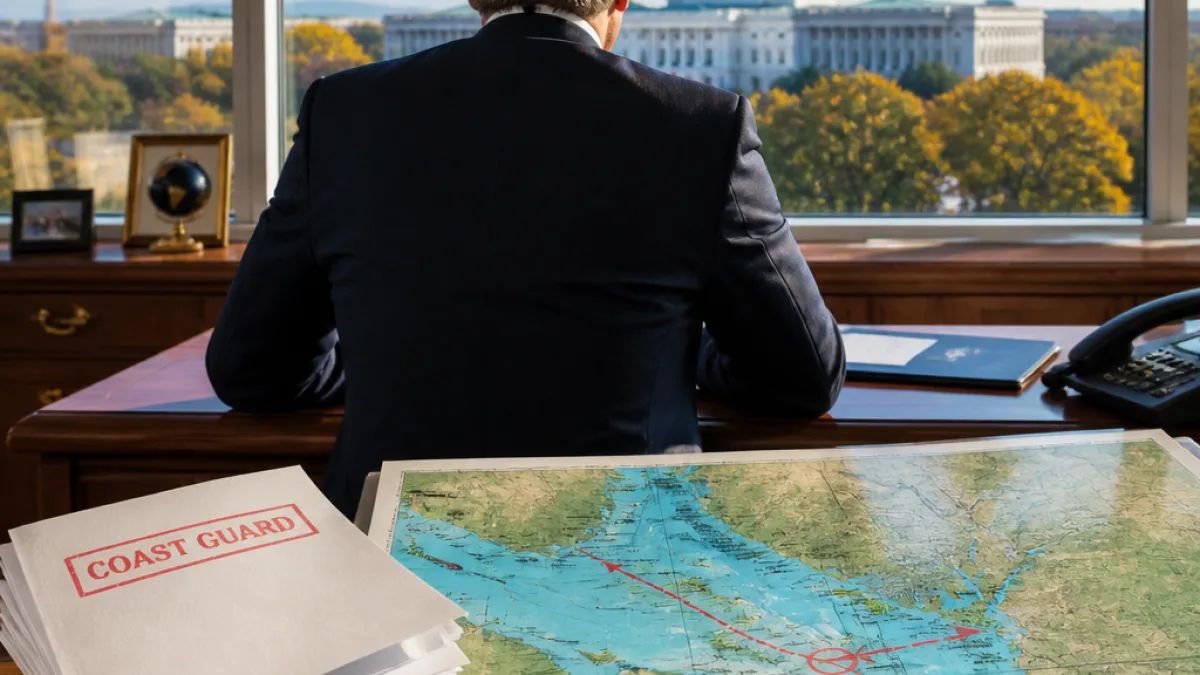
A United States congressman is pressing federal maritime authorities to revisit cross-border oil-spill response arrangements after news that a pipeline from Alberta to British Columbia would boost tanker traffic through waters near the Canada–U.S. border.
U.S. lawmaker seeks answers from Coast Guard
Rep. Rick Larsen, the top Democrat on the U.S. House Transportation and Infrastructure Committee, wrote to a senior official at the U.S. Coast Guard this week requesting details about how the two countries coordinate under a joint pollution contingency plan. The appeal follows the announcement of a proposed pipeline carrying oil to the Roberts Bank terminal in B.C., located a few kilometres by water from the Canada–U.S. border.
Larsen told reporters and officials he expects the pipeline will increase oil tanker traffic in the Salish Sea and warned of heightened environmental risk. In his letter he framed the concern bluntly, saying the increased traffic comes “
with it the risk of catastrophic oil spills.”
Cross-border contingency plan under scrutiny
The congressman’s request focuses on the joint Canada–U.S. pollution contingency plan, a framework that outlines how the two countries prepare for and respond to marine oil pollution incidents that could harm ecosystems along both coasts. Larsen wants the Coast Guard to outline coordination efforts, preparedness levels and whether current plans are adequate in light of the pipeline announcement.
He also indicated he will communicate with Canadian officials to express opposition from constituents in his Washington State district, saying he will tell his Canadian counterparts why the people he represents “
oppose this pipeline.”
Why this matters to Alberta
Although the pipeline’s terminal is in B.C., decisions that increase tanker activity near the Salish Sea have direct implications for Alberta’s energy industry and reputation. Any change in shipping patterns can influence market access, public opinion, regulatory scrutiny and cross-border relations, particularly when the risk of marine pollution becomes prominent in public debate.
- Who is involved: Rep. Rick Larsen and the U.S. Coast Guard.
- What triggered the call: Announcement of a pipeline from Alberta to Roberts Bank terminal in B.C.
- Primary concern: Increased oil tanker traffic to the Salish Sea and potential catastrophic oil spills.
Context and potential consequences
The joint contingency plan that Larsen referenced is intended to manage transboundary oil-pollution threats, establishing lines of coordination for prevention, preparedness and response. A request for a review from a senior U.S. lawmaker signals that Washington is seeking clarity on whether existing arrangements reflect current and projected shipping volumes and risks.
For Alberta, the measure illustrates the international dimension of pipeline projects: shipping and terminal siting decisions in one province can prompt political and regulatory reactions in another country. Those reactions could influence timelines, environmental assessments and broader public debate around energy infrastructure.
Details available so far
Public reporting on the matter so far is limited to statements and the congressman’s letter seeking information. The Canadian Press report that provided the initial account notes the pipeline would terminate at Roberts Bank — a marine terminal situated a few kilometres by water from the Canada–U.S. border — and that Larsen has requested the U.S. Coast Guard set out its coordination efforts under the bilateral spill-response framework.
| Item | Detail |
|---|---|
| U.S. lawmaker | Rep. Rick Larsen, top Democrat on House Transportation and Infrastructure Committee |
| Authority contacted | U.S. Coast Guard |
| Pipeline destination | Roberts Bank terminal, British Columbia (a few kilometres by water from the Canada–U.S. border) |
| Main concern | Increased oil tanker traffic in the Salish Sea and potential for catastrophic oil spills |
What to watch next
Readers should expect follow-up reporting on whether the U.S. Coast Guard responds to Larsen’s request by opening a formal review, what specific contingency-plan elements are assessed, and whether Canadian agencies engage directly with U.S. counterparts. Any formal review or adjustments could factor into ongoing regulatory and political discussions in both countries about the pipeline and marine safety.
The request also underscores how infrastructure projects in western Canada remain enmeshed with international stakeholders and strategic environmental considerations. As the debate continues, officials on both sides of the border will be watched for details on preparedness, response capacity and cross-border cooperation.
— Reporting and file preparation by The Canadian Press contributed to this story.