An Ottawa hobbyist has spent the last decade assembling tiny, exacting recreations of Canadian political moments using Lego minifigures, printed backgrounds and occasional paint touch-ups, producing roughly 800 posts that chronicle public life in miniature.
A political archive in plastic bricks
The project, known online as PoliLego, is the work of Kevin Bosch, an Ottawa-based illustrator who draws on a long connection to political life. Bosch said the account began with playful scenes — an early one depicted Justin Trudeau in a charity boxing match — and included memes about then-prime minister Stephen Harper’s hair. Over about ten years, those early amusements grew into a steady stream of recreated moments featuring politicians, public figures and cultural milestones.
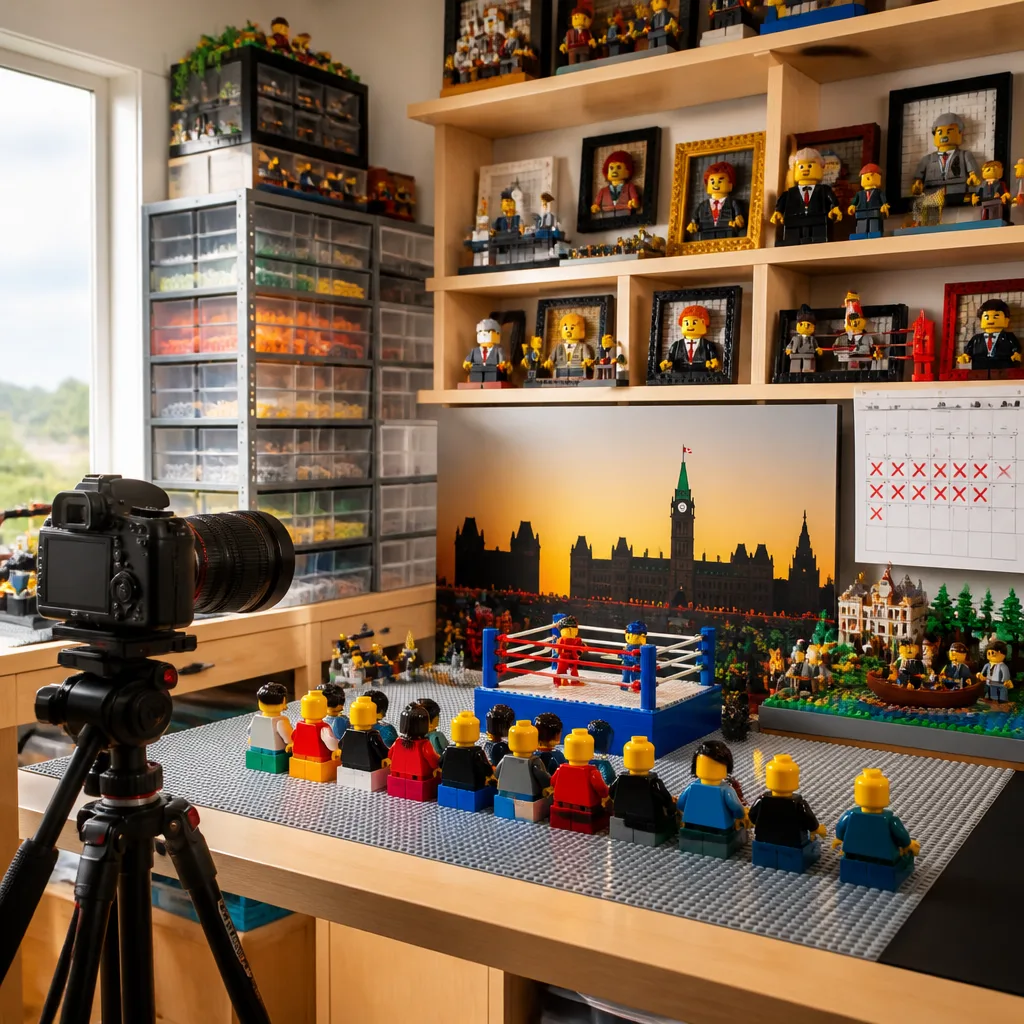
In a spare room at his home, Bosch keeps his Lego collection sorted by body type, clothing colour and hair.
“It kind of looks like a rainbow,”he said of the neatly organised bricks. That room is where he stages the miniature vignettes, arranging minifigures in front of printed photographs or hand-painted backdrops to reproduce key episodes in Canadian public life.
Subjects range from politicians to astronauts and authors
Recent posts have represented a range of figures and events. Bosch recreated scenes featuring Jeremy Hansen, the astronaut named the first Canadian to go to the moon, and Maggie Helwig, the Toronto author who won the Shaughnessy Cohen Prize. The scenes vary in popularity: a depiction of Queen Elizabeth II approaching the pearly gates — complete with handbag and crown details — attracted more than 1,500 likes, while a more recent LEGO rendering of Stephen Harper’s official portrait unveiling received about 700 likes.
Bosch did not set out to be a chronicler of Ottawa life. He grew up in Calgary and said he liked Lego as a child, but his deeper engagement with the medium came later through his children, particularly his son, Ben, who would tackle complex sets at a young age. Bosch’s own work on Parliament Hill for the Liberal party, when Justin Trudeau was still the opposition leader, also informed the project and some of its earliest scenes.
Small-scale work, broad resonance
PoliLego posts mix simple craft with political observation. Bosch sometimes adds small paint adjustments to pop-on Lego hairpieces and uses printed photo backgrounds to place his figures in recognisable settings. The result is both playful and archival — a visual shorthand that distils public moments into instantly readable tableaux while preserving the humour of the original incidents.
The project demonstrates how everyday creativity can document political life outside traditional institutions. By reducing complex stories to a handful of plastic figures, Bosch has created a running, publicly accessible record of moments that resonated with followers online.
- Duration: Roughly 10 years of posts
- Output: About 800 PoliLego posts
- Notable reactions: Queen Elizabeth II Lego post >1,500 likes; Stephen Harper portrait post ≈700 likes
| Metric | Value |
|---|---|
| Approximate number of posts | 800 |
| Project span | 10 years |
| Most-liked recent post | >1,500 likes (Queen Elizabeth II scene) |
| Harper portrait post | ~700 likes |
While the project is light in tone, it underscores a broader trend in which social media and hobbyist communities create alternative archives of political life. For followers, PoliLego is part nostalgia, part satire and part visual history — a way to look again at familiar faces and episodes rendered in miniature.
As the body of work grows, it offers scholars, journalists and the public a compact, accessible lens on how political moments are remembered and shared outside conventional outlets. For now, Bosch keeps building: arranging bricks, sorting colours and shaping tiny scenes that make the nation’s political life a little more tangible, and a lot more playful.