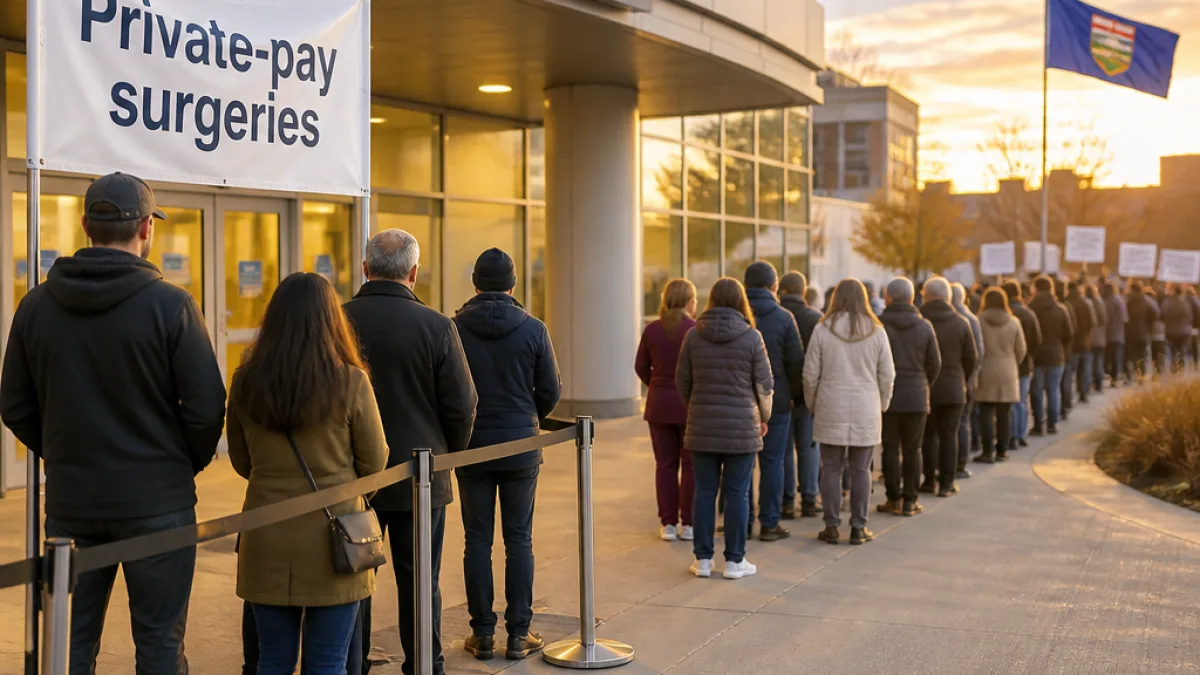
Alberta will permit patients to pay directly for surgical procedures beginning this fall, a move the provincial government says will help reduce public wait lists but which critics argue could deepen inequity in health care and strain the public system.
What the government says
Premier Danielle Smith has framed the policy as a practical response to lengthy wait times, arguing private payments will allow some Albertans to obtain surgeries sooner and thereby shorten publicly funded lists for those who cannot pay. The exact rollout details and which procedures will be eligible have been left to provincial regulations.
"Starting in the fall, Albertans will be able to pay out of pocket for surgery."
Concerns from critics and analysts
Health-policy experts and advocates have raised immediate objections. They say permitting private payment risks shifting resources — staff, operating-room time and investments — away from hospitals that serve patients through the public system. That could leave those unable to pay facing longer waits and understaffed facilities.
Andrew Longhurst, a senior researcher and political economist at the Canadian Centre for Policy Alternatives, discussed the legislation and its broader implications on a local podcast. Critics also contend the change may be inconsistent with the Canada Health Act, which underpins federal health funding and prohibits extra-billing for insured services.
Federal role and enforcement questions
Provinces have some latitude in organizing health services, but the Canada Health Act sets conditions for federal transfers, including the principle of public administration and prohibitions against user charges for insured services. Observers are asking whether Ottawa will challenge Alberta’s approach or pursue remedies if it determines the policy violates the act.
So far, provincial officials have emphasised patient choice and easing pressure on wait lists; federal responses remain uncertain in public reporting to date.
Local impact and practical considerations
If implemented, the policy could have multiple effects within Alberta’s hospitals and clinics:
- Patients with means may access certain procedural slots sooner by paying privately.
- Public patients could see mixed results: some wait lists may shorten if private-pay activity uses separate capacity, while others could lengthen if health-care workers are shifted to private-pay streams.
- Rural and Indigenous communities — already facing recruitment and access challenges — may not benefit if private services cluster in larger centres.
Health-system observers point out that the net effect will depend on how the province structures the policy: whether private-pay procedures occur in private clinics or within public facilities, how staffing is allocated, and which procedures are eligible.
Where stakeholders stand
| Supporters | Concerns raised by critics |
|---|---|
| Government: reduce wait times, increase choice | Equity: prioritising those who can pay |
| Some patients: faster access to needed surgery | System resources: potential diversion from public care |
| Proponents argue market options relieve pressure on public lists | Legal: possible conflict with the Canada Health Act |
What to watch next
Key details to emerge in coming weeks will shape the policy’s impact: whether private-pay surgeries will be permitted inside publicly funded hospitals, the list of eligible procedures, staffing and scheduling rules, and whether the federal government takes any formal steps under the Canada Health Act.
Public-health advocates say monitoring will be essential to track whether wait times for publicly funded procedures actually improve and to assess effects on staffing and access in smaller communities.
The announcement has already prompted debate across Alberta’s health sector and among national health-policy experts. As the fall implementation date approaches, both provincial regulations and potential federal responses will determine whether the change becomes a short-term fix for access problems or the start of a broader reordering of how surgical care is delivered in the province.