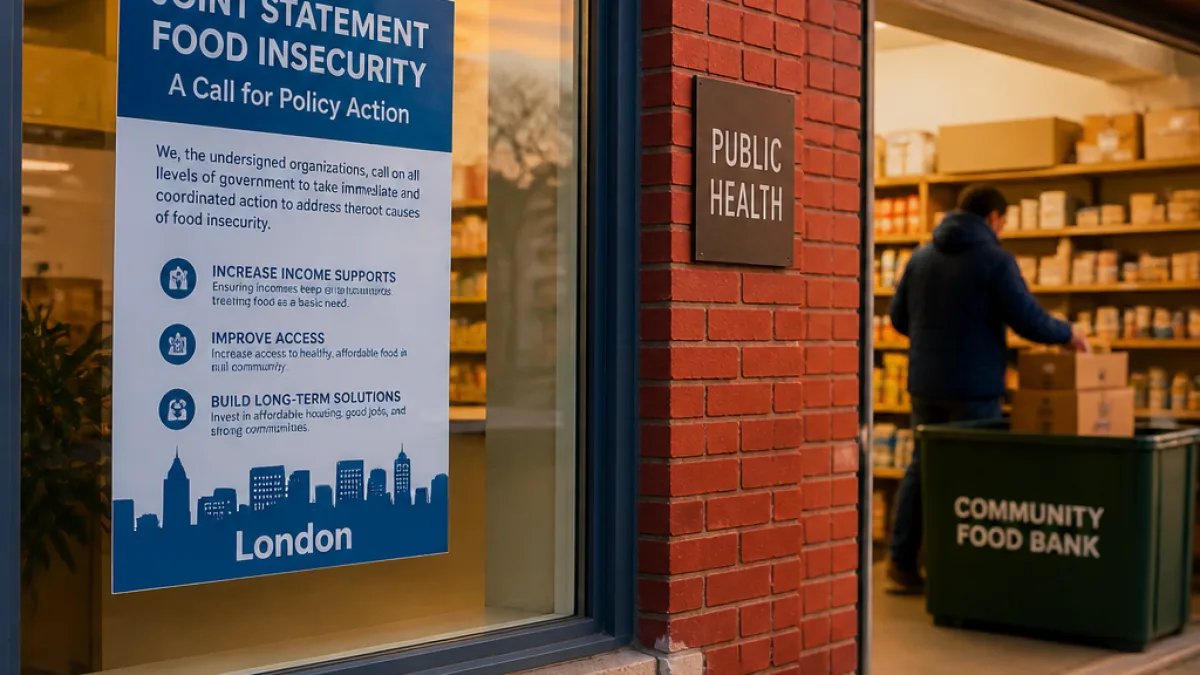
Public health units across southwestern Ontario have issued a joint statement saying food insecurity is increasing in the region and must be treated as a preventable public‑health issue. The health units urged provincial and federal governments to bolster income supports to reduce the need for emergency food assistance and address the root causes of hunger.
Health units frame the problem as preventable
The combined message from local public health authorities frames food insecurity not as an isolated social-service problem but as a matter with direct consequences for population health. Officials note that unstable access to sufficient, culturally appropriate and nutritious food contributes to poorer physical and mental health across the lifespan and places additional strain on local health-care and social services.
While the joint statement did not enumerate specific case counts or neighbourhood-level statistics, the coordinated appeal reflects concerns seen across many communities: rising costs, precarious work, inadequate benefits and other economic pressures that push more households to rely on food banks, community fridges and other emergency supports.
What public health units are asking for
In their call to action, health units urged governments to focus on income supports as a primary lever to reduce food insecurity. That means measures that ensure households have predictable, adequate income to meet basic needs, rather than relying solely on emergency food systems to fill gaps.
- Income stability: stronger social supports and programs that reduce the number of people needing emergency food assistance.
- Prevention focus: policies that target underlying risk factors such as housing affordability and precarious employment.
- Coordination: better alignment between public health, social services and community organizations to identify at‑risk households earlier.
Health officials emphasised prevention — intervening before households reach crisis — as a more effective and sustainable approach than expanding emergency food distribution alone.
Local impact and community response
Across the region, community groups and service providers continue to see increased demand at food banks and meal services. Public health units pointed to the limits of those services: while crucial for immediate needs, food banks cannot substitute for stable household income or address the health consequences of chronic food insecurity.
Public health experts have long highlighted links between food insecurity and a range of health outcomes, including chronic disease management, child development and mental-health challenges. As the health units noted, addressing food insecurity can reduce pressure on primary care and emergency services by improving population resilience and overall well‑being.
Practical information for residents
Residents concerned about food access are encouraged to contact their local public health unit or municipal social service office for information on available supports, including income‑related programs, housing assistance and emergency services. Community organisations such as food banks and meal programs remain essential resources for immediate needs.
Public health officials also recommend that neighbours and community groups stay alert to signs of food insecurity among friends, family and neighbours and help connect people to supports before needs become acute.
Policy implications and next steps
The health units’ joint statement is an appeal to both provincial and federal policymakers to prioritise income-based solutions — for example, through benefit programs, wage supports or changes to social assistance eligibility. Health units argue these changes would be the most direct and effective route to reducing reliance on emergency food systems and improving long‑term population health.
| Issue | Suggested public‑health response |
|---|---|
| Rising demand for emergency food | Strengthen income supports to reduce reliance on food banks |
| Health impacts of food insecurity | Integrate screening and referrals in primary care and public‑health programs |
| Service coordination | Improve alignment between health units, social services and community agencies |
The joint appeal from southwestern Ontario’s public health units adds to a national conversation about how best to tackle food insecurity. Local officials say momentum is needed now so policy changes can prevent harm rather than respond to it after the fact.
For residents seeking help or more information, contacting your municipal social services or regional public health unit is the recommended first step. Community organisations also publish up‑to‑date lists of emergency food resources and meal programs on municipal and social-service websites.
As the region navigates rising costs and economic uncertainty, public health officials say addressing food insecurity through income stability will protect the health of children, seniors and working families and strengthen community resilience.