Canada’s emergency departments are experiencing significant staff losses and widespread reductions in clinical hours as physicians grapple with persistent burnout, according to an editorial published in the Canadian Medical Association Journal (CMAJ).
Scope of the problem
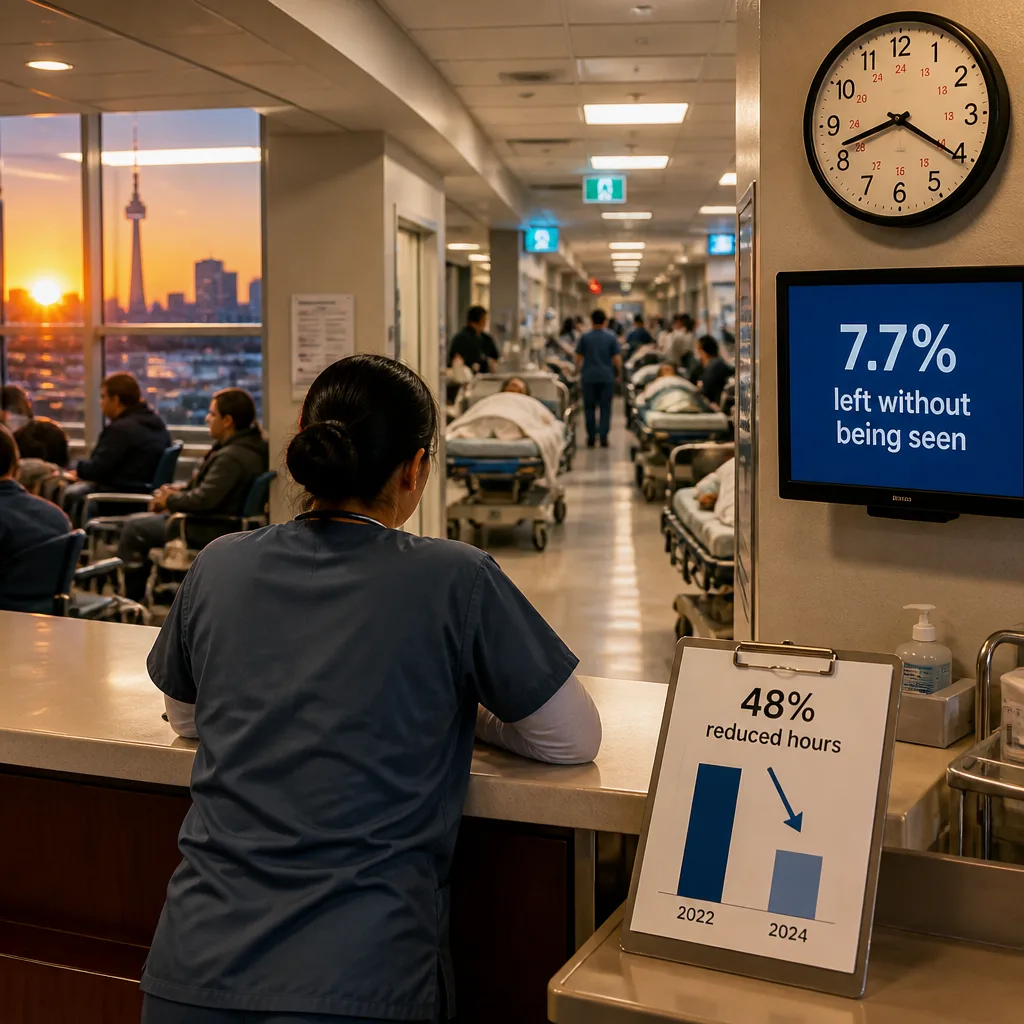
The editorial, penned by CMAJ deputy editor Catherine Varner, synthesizes survey findings and system-level indicators to outline a workforce in distress. Among emergency physicians who were surveyed five years earlier, 10 per cent no longer practised emergency medicine, while an additional 48 per cent had reduced their clinical hours. The piece also cites a Canadian Institute for Health Information (CIHI) report showing emergency department length of stay for admitted patients worsened in 2025 and that 7.7 per cent of patients left without being seen.
“Emergency physicians described helplessness and resignation while working in overcrowded emergency departments,”
Varner writes that many clinicians feel unable to provide timely or safe care in crowded waiting rooms and hallways, and that these conditions are driving departures and reductions in availability.
Burnout, depersonalization and system strain
The editorial reports that physicians continue to experience high levels of burnout and depersonalization that have not abated since the COVID-19 pandemic. A previously published figure referenced in the piece indicates that 62 per cent of health professionals across Canada report feeling burned out — a trend with implications for recruitment, retention and organisational functioning.
Varner links the clinician experience to measurable system effects: longer stays for admitted patients, more patients leaving without being seen, and increasing difficulty for employers to deliver timely emergency care to injured or ill workers.
Pressure, blame and public scrutiny
On top of workload and system constraints, emergency clinicians are facing heightened public scrutiny and blame when adverse outcomes occur. The editorial highlights instances where individual providers were publicly named in provincial inquiries into deaths that occurred in emergency department waiting areas, citing the cases of Prashant Sreekumar in Edmonton and Adam Burgoyne in Montréal as illustrative.
Varner notes these events compound feelings of helplessness among staff, contributing to decisions to leave emergency medicine or cut shifts.
Key figures at a glance
| Measure | Reported value |
|---|---|
| Emergency physicians who left practice | 10% |
| Emergency physicians who reduced hours | 48% |
| Health professionals reporting burnout | 62% |
| Patients leaving ED without being seen (2025) | 7.7% |
Consequences and considerations
The combination of attrition and reduced hours has immediate and downstream consequences. With fewer physicians available, emergency departments may struggle to maintain timely assessments and treatments, potentially increasing wait times, adverse events and pressure on inpatient services. The editorial warns that continuing on this trajectory risks undermining employers’ ability to provide prompt emergency care to injured or ill workers and the public at large.
Varner’s commentary underscores that the drivers extend beyond individual resilience and point to system-level failures: overcrowding, insufficient capacity, and the emotional toll of repeated exposure to high-risk situations and public criticism. The editorial calls attention to the need for structural responses rather than relying solely on individual-level solutions.
What the data suggest for policy
Although the editorial is not an empirical research article, it leverages survey data and CIHI reporting to underscore an urgent policy challenge. Addressing it will likely require a mix of measures — including improving emergency department capacity, streamlining patient flow, investing in workforce supports and retention strategies, and reforming accountability processes so clinicians are not unfairly blamed for system-level shortcomings.
As emergency departments nationwide contend with these strains, the CMAJ editorial functions as a call to action to policymakers, health system leaders and professional bodies to confront both the human cost and operational risks of a burned-out emergency workforce.