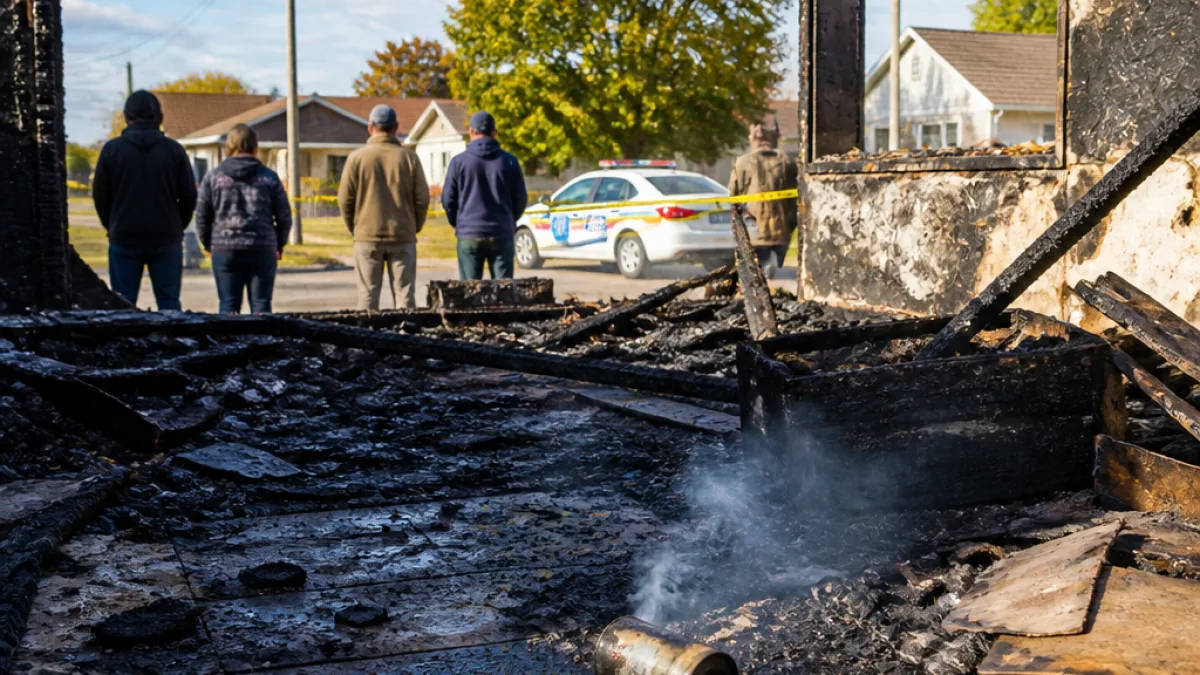
New Brunswick RCMP have confirmed that a tear-gas canister unintentionally started a house fire during an April 2025 standoff at Kingsclear First Nation, about 25 kilometres west of Fredericton. The blaze destroyed the residence on Tomahawk Avenue, a councillor said, and the force’s admission was only disclosed to media this week after it was not included in the original 2025 news release.
What happened during the standoff
Police say officers deployed chemical irritant to force a barricaded suspect from the home after he reportedly fired a weapon toward responding officers. The RCMP now acknowledge the canister landed inside the building and ignited, producing a fire that ultimately levelled the house.
Patrick Polchies, a councillor for Kingsclear First Nation, described the damage.
“The fire totalled the place, it was nothing but a pile of rubble,”he told The Canadian Press, and a new structure has since been built on the property.
Charges and operational context
At the time, police arrested a 34-year-old man who faces multiple charges stemming from the incident, including 16 counts of attempted murder and counts for firing at police. The RCMP statement last year indicated the use of tear gas as a tactic to compel the individual to exit the house.
Commenting on the tactical risks, Thor Eells — a retired police commander from Colorado Springs who has trained tactical units in Canada — said there is always a possibility that the use of chemical agents can lead to fire, although it is uncommon. He noted that interactions between crowd-control agents and household materials can create an ignition risk, and that operational priorities often force officers to defer firefighting until a suspect is secured.
“You can’t put firefighters or fire service in a dangerous situation where they could be shot,”
Eells added that securing the scene and minimising the immediate threat to life are primary considerations for tactical officers.
Community impact and transparency questions
The RCMP’s belated confirmation has prompted local concern about transparency and the effects of tactical decisions on Indigenous communities. Kingsclear First Nation residents and leaders have previously expressed alarm at heavy police responses in and around the reserve.
The demolition of a family home during a police operation raises sensitive questions about proportionality, accountability and the communication of operational consequences to affected communities. Polchies’s description of the property as destroyed underlines the personal cost of the action; the replacement of the structure does not erase the physical and emotional toll of such an event.
Public-safety trade-offs in tactical operations
Experts say the choice to use chemical agents is often framed by the immediate need to reduce risk to officers and the public; however, that choice carries collateral hazards, including potential ignition sources and harm to bystanders. Fire crews are typically unable to enter until the scene is secured, which can allow a small ignition to grow into a destructive blaze.
That operational calculus — balancing an active threat against the risk of property damage and civilian injury — is at the centre of discussions about use-of-force protocols, training and equipment. Community leaders and legal advocates frequently call for clearer rules and more robust reporting when operations result in significant property damage or personal loss.
Key facts at a glance
- Location: Tomahawk Avenue, Kingsclear First Nation, near Fredericton.
- Timing: April 2025 standoff; RCMP confirmation disclosed to media in late July 2026.
- Outcome: House was destroyed; a new structure has since been built.
- Legal: A 34-year-old man was arrested and charged with 16 counts of attempted murder and with firing at police.
| Item | Detail |
|---|---|
| Incident date | April 2025 |
| Location | Kingsclear First Nation (Tomahawk Avenue) |
| Device | Tear-gas canister |
| Damage | House demolished; rebuilt thereafter |
| Charges | 34-year-old charged with 16 counts of attempted murder and firing at police |
What comes next
There has been no public indication of disciplinary action or a formal independent review specifically tied to the fire, beyond the original reporting on the standoff and subsequent court processes related to the accused. The RCMP's later acknowledgement may prompt renewed calls for detailed incident reporting and for clearer communication with community leaders after operations that produce serious collateral damage.
For residents and policy-makers alike, this incident highlights the tensions inherent in high-risk policing: the imperative to neutralize an immediate threat while preventing unintended harm to people and property. As questions linger, communities will watch for further clarification from police authorities about what led to the ignition and what steps may be taken to prevent similar outcomes in future tactical responses.
— Reporting from Fredericton.