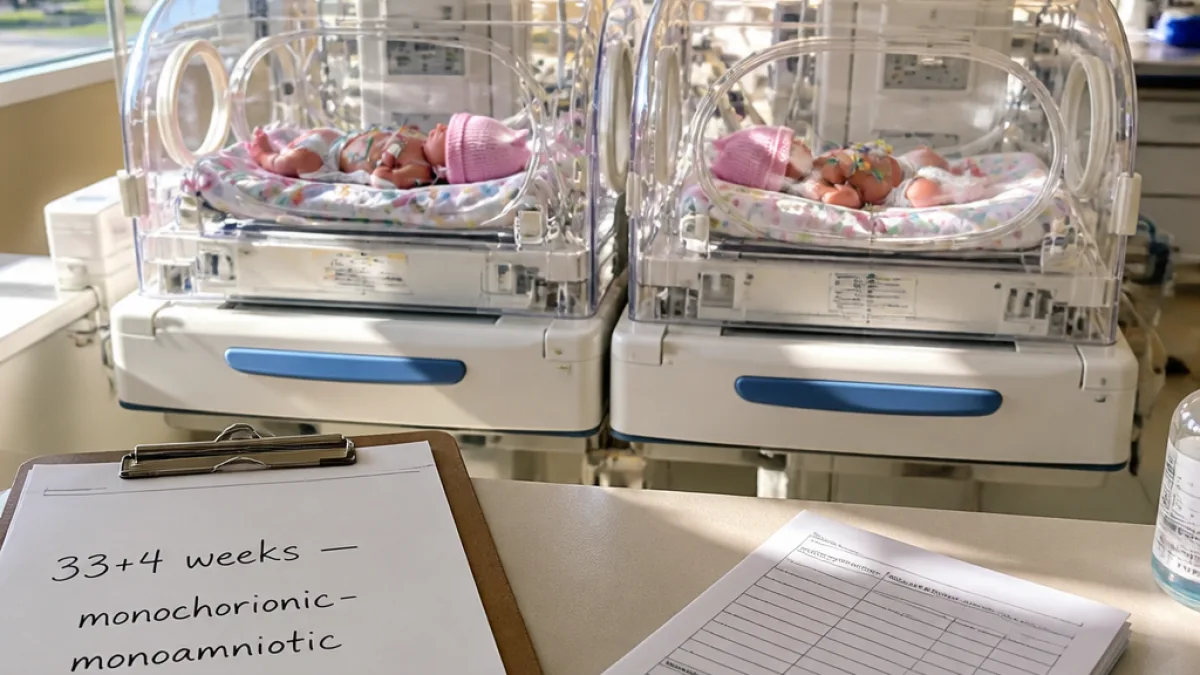
A Chatham mother has delivered what medical specialists call one of the rarest forms of twins: monoamniotic‑monochorionic twins, commonly referred to as "mono‑mono". The babies — identical girls — were born on July 23 and are receiving specialised care in the Neonatal Intensive Care Unit (NICU) at a hospital in London.
High‑risk pregnancy monitored closely
The mother, identified as Kaley Johnston‑Wilson, learned of the pregnancy during her first ultrasound and discovered at about 12 weeks that she was carrying mono‑mono twins. According to Hamilton Health Sciences, mono‑mono twins occur in roughly 1 in 10,000 pregnancies, arising when a single fertilized egg splits late in development, resulting in twins that share both a single placenta and a single amniotic sac.
Because mono‑mono pregnancies carry a heightened risk of complications such as cord entanglement and twin‑to‑twin transfusion, Johnston‑Wilson said she was placed under close observation for several months. The babies were delivered by cesarean section at 33.4 weeks gestation.
"I had some hesitation because I did some research and I was scared of the worst‑case scenario. But after a while, and my nerves were calmed, I was actually very excited for the outcome of twins," Johnston‑Wilson told CK News Today.
Care and expected transfer to Chatham
The twins remain in the London NICU where staff are providing the specialised neonatal supports often required by premature and high‑risk infants. Johnston‑Wilson said the babies are "doing very well" and that she expects them to be transferred to a Chatham hospital when a bed becomes available, likely within a couple of weeks.
She also explained that delivery by cesarean is standard in mono‑mono cases because vaginal birth is generally avoided due to the high risk of cord complications and serious circulatory imbalance between twins.
- Type of twins: Monoamniotic‑monochorionic (mono‑mono)
- Date of birth: July 23
- Gestational age at birth: 33.4 weeks
- Current location: Neonatal Intensive Care Unit, London hospital
- Planned transfer: To Chatham hospital when a bed is available
Local context and implications
For families in Chatham and surrounding communities, the case highlights both the rarity of some twin pregnancies and the regional nature of specialised perinatal care. London hospitals and other tertiary centres commonly accept high‑risk obstetrical transfers from smaller centres, including Chatham, where neonatal capacity and specialised maternal‑fetal medicine resources are more limited.
Officials did not provide a timeline for the transfer beyond the mother's expectation that it would occur when a bed opens at the Chatham facility. The family said there are no special public plans for welcoming the infants home and that their immediate priority is a smooth transition from the NICU to local care.
| Fact | Detail |
|---|---|
| Rarity | About 1 in 10,000 pregnancies (Hamilton Health Sciences) |
| Delivery method | Cesarean section (standard for mono‑mono pregnancies) |
| Gestational age | 33.4 weeks |
| Initial care | NICU in London; transfer to Chatham hospital planned |
The mother recounted an emotional journey from initial alarm after researching the condition to growing excitement as her pregnancy progressed under medical supervision. Health professionals typically recommend heightened monitoring for mono‑mono pregnancies, often including more frequent ultrasounds and inpatient observation in later pregnancy, to reduce the risk of catastrophic complications.
The story has drawn local interest both for its rarity and as a reminder of how regional health systems collaborate to support high‑risk births. As the family awaits transfer back to Chatham, neighbours and community members are following the twins' progress and hoping for a smooth move to local care.
Further details about the twins' condition and the timing of their transfer to Chatham will depend on clinical assessments and bed availability at the local hospital.