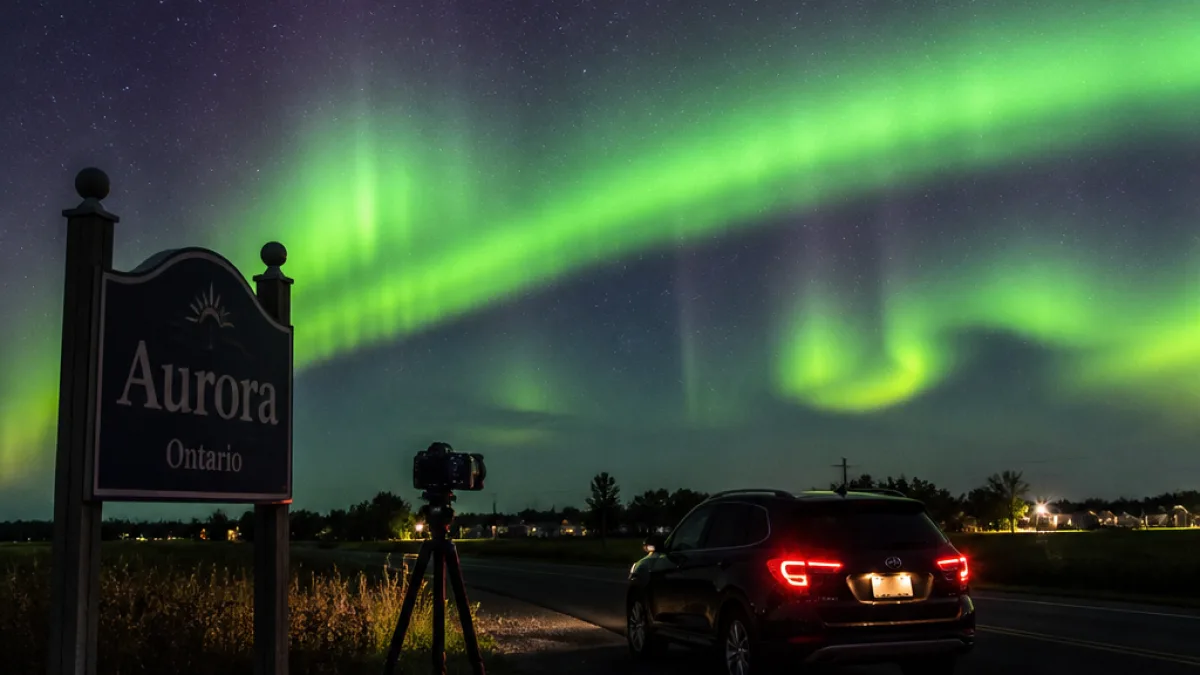
Residents of Aurora and other parts of southern Ontario may get an unexpected chance to see the northern lights as a forecast from the U.S. National Oceanic and Atmospheric Administration (NOAA) predicts increased geomagnetic activity Sunday night.
What NOAA is forecasting
NOAA’s three-day outlook indicated the Kp index — a global measure of geomagnetic activity — could reach about 4 out of 9 for Sunday night. That level means the auroral oval can expand farther from the magnetic poles and the lights may appear brighter and more structured than on quieter nights.
“The aurora could move farther from Earth’s magnetic poles, while appearing ‘brighter’ with more ‘motion and formations.’”
The U.S. forecast did not predict space weather that would cause major disruptions, but it did leave open the possibility that activity could increase into Monday morning.
How that matters for Aurora
For local viewers, a Kp of four is the key detail. The higher the Kp index, the farther south the aurora can be visible. While NOAA’s release highlighted U.S. northern states as likely viewing areas, the same geomagnetic conditions that send the auroral oval south over those states can allow displays to be seen from parts of southern Ontario on nights when skies are dark and clear.
- Timing: The aurora tends to be most active between about 10 p.m. and 2 a.m., though activity can occur outside that window.
- Where to look: Find a northern horizon with an unobstructed view, away from city lights.
- Conditions: Clear skies and low moonlight improve visibility; cloud cover will obscure displays even if geomagnetic activity is elevated.
Practical tips for viewers and photographers
Anyone hoping to catch the lights should aim to get as far from light pollution as possible. In Aurora, that typically means driving to darker rural spots north or east of the town. Municipal or provincial parks, or any open area with a clear view to the north, will give the best vantage points.
Photographers can capture impressive images with modest equipment. Smartphone cameras have improved low-light performance, but long-exposure settings and a tripod will yield better results. Recommended steps include turning off flash, using a night or long-exposure mode, and keeping the camera steady with a tripod and timer. Shooting in RAW format is advised if the device supports it.
What to expect and what not to expect
A Kp of around four does not guarantee a vivid, city-spanning curtain of colour; sometimes the aurora shows as a faint glow or brief arcs low on the horizon. Conversely, conditions can change quickly if geomagnetic activity increases, producing stronger and more dynamic displays.
| Forecast element | Implication for viewers |
|---|---|
| Kp index ≈ 4 | Possible visibility at lower latitudes; chance of brighter, moving structures |
| Timing | Best window ~10 p.m.–2 a.m.; check local skies and forecasts for timing shifts |
| Cloud cover | Will prevent sightings even if geomagnetic conditions are favourable |
NOAA’s advisory emphasises that viewers should watch the sky and local weather conditions. The agency’s maps and real-time aurora alerts are useful tools for anyone planning a viewing trip.
For Aurora residents who plan to go out and look, remember personal safety: dress for the weather, avoid standing on roadways while looking north, and respect private property. If planning to travel outside town for darker skies, check park access and any provincial restrictions in advance.
Local astronomy clubs and community groups sometimes organise viewing outings when geomagnetic forecasts indicate a higher chance of activity; those groups can offer tips on where to go and how to photograph the lights.
While a spectacular all-night light show is not certain, the NOAA forecast gives Aurora residents a reasonable reason to keep an eye on the northern sky late Sunday and into Monday morning.